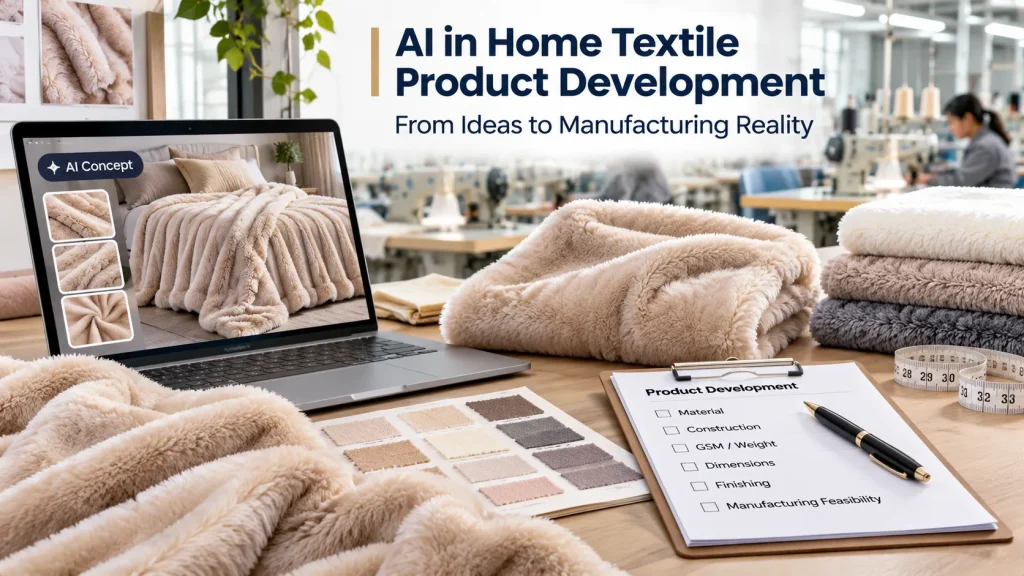
Imagine your brand is planning to introduce a new Bubble Faux Fur Blanket to its collection.
You have already chosen the distinctive bubble-textured surface, but one important product decision remains:
Should the blanket use bubble faux rabbit fur on one side or on both sides?
This is more than a visual choice. The construction affects the reverse fabric, material specifications, finished weight, hand feel, fabric consumption, sampling requirements, and ultimately how quotations should be compared.
At Apex Textile Mill, we work with buyers on both single-sided and double-sided bubble faux rabbit fur constructions for OEM and ODM blanket projects. Defining the construction early helps buyers compare samples and quotations more consistently before moving into bulk production.
For brands, wholesalers, and importers, the right choice depends on the intended appearance, product positioning, target specifications, and cost structure rather than on the assumption that one construction is automatically better.
Quick Answer
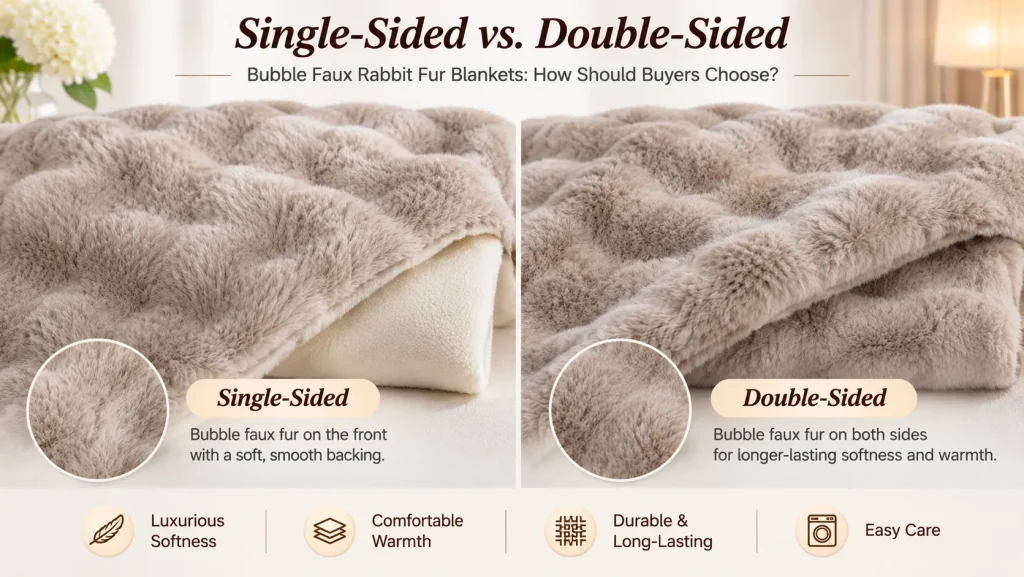
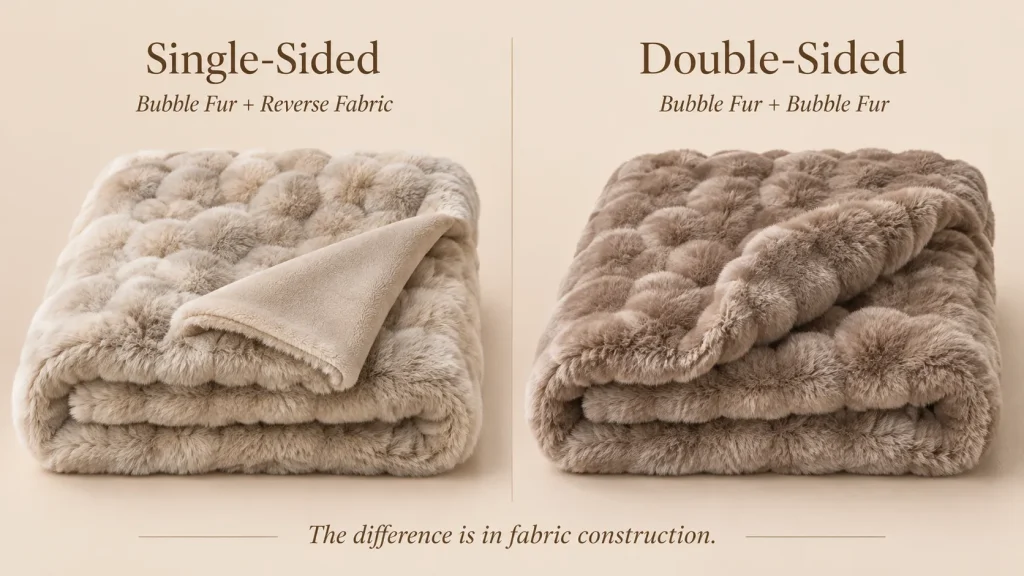
A Single-Sided Bubble Faux Fur Blanket uses bubble faux rabbit fur on the front and a selected complementary fabric on the reverse.
A Double-Sided Bubble Faux Fur Blanket is made by combining two pieces of bubble faux rabbit fur fabric, with the bubble-textured surface visible on both sides.
Neither construction is automatically better. The appropriate option depends on the required appearance, hand feel, finished weight, reverse-fabric strategy, target cost, and intended market.
1. Single-Sided vs. Double-Sided: What Is the Actual Construction Difference?
The main difference is how the front and reverse surfaces are developed.
| Comparison | Single-Sided | Double-Sided |
| Front | Bubble faux rabbit fur | Bubble faux rabbit fur |
| Reverse | Selected complementary fabric | Bubble faux rabbit fur |
| Visual Effect | Bubble texture mainly on the front | Bubble texture visible on both surfaces |
| Construction | Bubble faux fur combined with a selected reverse fabric | Two pieces of bubble faux rabbit fur fabric combined and sewn together |
| Key Development Question | How should the reverse fabric work with the front? | How should the two faux fur surfaces match after sewing? |
| Weight & Cost Evaluation | Strongly influenced by reverse-fabric selection | Influenced by the specifications of both faux fur pieces |
Single-Sided Bubble Faux Fur Blanket
A Single-Sided Bubble Faux Fur Blanket features bubble faux rabbit fur on the front, while the reverse is developed using a different selected fabric.
Depending on the product concept, the reverse may use a dense short-pile polyester plush fabric, sometimes commercially described by suppliers as “milk velvet,” soft plush, or another suitable fabric construction.
This gives buyers more flexibility when developing the hand feel, appearance, finished weight, and price positioning of the blanket.
However, the reverse fabric should not be treated as a secondary detail.
Important factors include:
- Thickness and flexibility
- Color coordination
- Surface character
- Hand feel
- Finished weight
- Overall product appearance
Two fabrics that look suitable when viewed as separate swatches may behave differently after they are sewn into a finished blanket. This is why the complete physical sample should be evaluated before approval.
Double-Sided Bubble Faux Fur Blanket
A Double-Sided Bubble Faux Fur Blanket is made by combining two pieces of bubble faux rabbit fur fabric and sewing them together, with the bubble-textured surface visible on both sides.
This construction is suitable when buyers want the distinctive bubble texture to remain visible regardless of which side of the blanket is displayed.
However, using the same type of fabric on both sides does not automatically guarantee a well-matched finished appearance.
Buyers should still define the relevant fabric composition, GSM, surface appearance, finished dimensions, and desired product weight.
The two pieces of fabric should also be evaluated together.
In particular, buyers should check whether their colors, bubble textures, thicknesses, and overall surface appearances are compatible after sewing.
The more important question is therefore not simply:
Do we want bubble faux fur on both sides?
It is:
What combination of fabric specifications and construction details will create the intended finished product?
2. Does Double-Sided Always Mean Better?
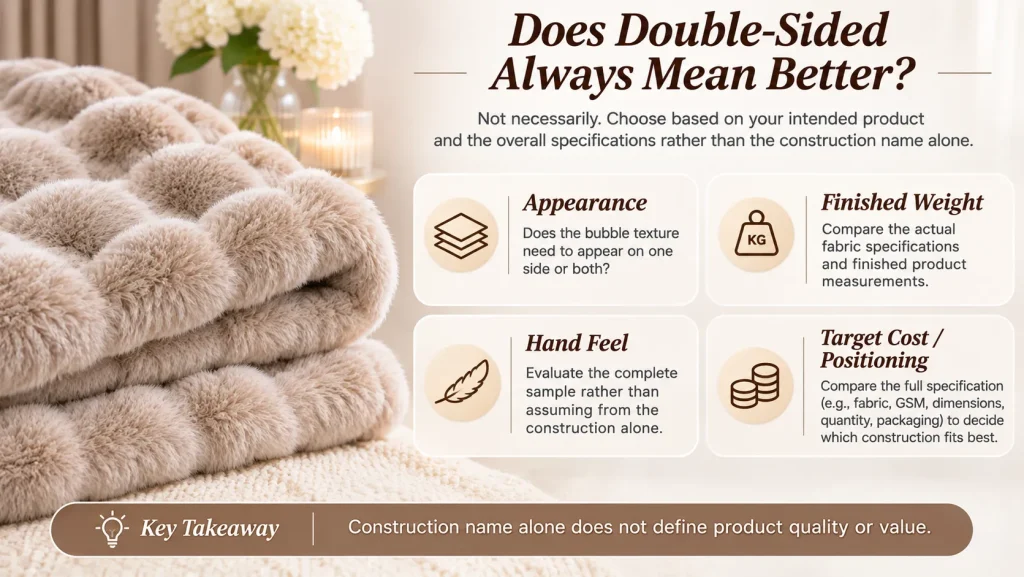
Not necessarily.
A double-sided construction can create a consistent bubble-textured appearance on both surfaces, but that does not automatically make it more suitable for every brand or wholesale collection.
The better construction is the one that supports the intended product.
Consider the Role of the Bubble Texture
If the bubble texture is intended to be a major design feature on both surfaces, a double-sided construction may fit the concept better.
If the front is the primary visual surface, a single-sided construction can provide more flexibility on the reverse while preserving the main bubble-textured appearance.
Consider Finished Weight and Hand Feel
The GSM and construction of each fabric affect the final blanket.
However, buyers should not assume that every double-sided blanket is automatically heavier, warmer, or softer than every single-sided blanket.
A single-sided design using a relatively heavy reverse fabric may produce a substantial finished product. Meanwhile, a double-sided blanket using different fabric specifications may have a different result.
For double-sided designs, the specifications of both bubble faux fur pieces should be considered together with the finished product weight.
The meaningful comparison is therefore based on actual fabric specifications and finished product measurements, not the construction name alone.
Consider the Target Price and Collection Position
Material consumption, fabric composition, GSM, dimensions, construction, production requirements, order quantity, and packaging can all affect quotation results.
A single-sided design provides more flexibility in reverse-fabric selection.
A double-sided design uses bubble faux rabbit fur on both surfaces, with two pieces of fabric combined and sewn together.
Neither should automatically be described as the more economical option without comparing the complete specifications.
The objective is not simply to choose more material. It is to choose the construction that best supports the intended product and market position.
3. How Should Buyers Compare the Cost of Both Constructions?
One common sourcing mistake is comparing two quotations without first checking whether the products are technically equivalent.
Two blankets may share the same finished dimensions and similar appearances but use different reverse fabrics, fabric weights, or constructions.
These differences can affect material consumption and production requirements.
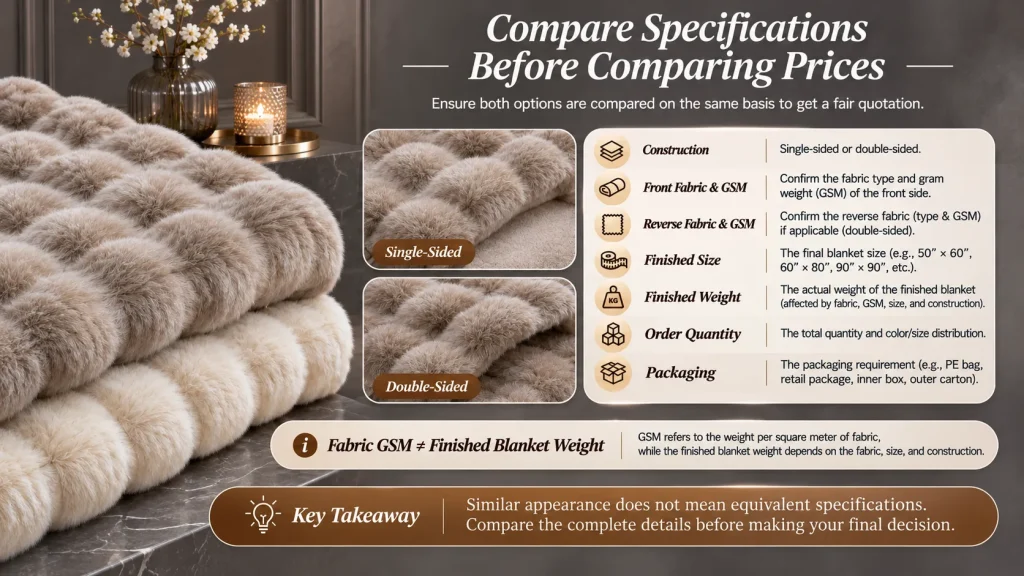
Before requesting a quotation for a Custom Bubble Faux Fur Blanket, buyers should confirm the following information.
| Comparison Item | What Buyers Should Confirm |
| Construction | Single-sided or double-sided bubble faux fur |
| Front Fabric | Composition and GSM |
| Reverse Fabric | Selected material and specifications where applicable |
| Fabric GSM | GSM of each relevant fabric piece |
| Finished Size | Required blanket dimensions |
| Finished Weight | Target weight or acceptable range where required |
| Color | Required color or approved color reference |
| Order Quantity | Estimated quantity per style and specification |
| Packaging | Individual and bulk-packing requirements |
Fabric GSM Is Not Finished Blanket Weight
This distinction is particularly important.
Fabric GSM and finished blanket weight are not the same measurement.
GSM describes the weight of a fabric per unit area.
The weight of the completed blanket is also influenced by finished dimensions, the reverse fabric where applicable, the two fabric pieces used in double-sided designs, sewing, and other product components.
For example, specifying the GSM of the bubble faux rabbit fur on the front does not by itself define the final weight of a single-sided blanket.
Similarly, for a double-sided design, the specifications of both fabric pieces should be considered when evaluating the finished product.
When comparing single-sided and double-sided quotations, use the same finished dimensions and clearly defined target specifications wherever possible.
This makes it easier to identify what is genuinely different between the proposed constructions instead of comparing prices for two technically different products.
4. What Should Buyers Check When Evaluating Samples?
Product photographs can communicate appearance, but they cannot fully show the physical construction and finished feel of a blanket.
For this reason, sample evaluation is especially important when choosing between single-sided and double-sided designs.
Bubble Texture and Surface Appearance
Check whether the bubble texture presents the intended appearance across the relevant surface.
For a double-sided product, review both sides rather than assuming the second surface will look exactly the same as the first.
Pay attention to the consistency of the bubble pattern and the overall surface appearance.
If the sample will become the approval reference, the expected appearance should be clearly understood before bulk production.
Front and Reverse Compatibility
This is particularly important for single-sided designs.
Review how the bubble faux rabbit fur front works together with the selected reverse fabric in terms of color, thickness, flexibility, texture, and hand feel.
For double-sided designs, evaluate whether the two pieces of bubble faux rabbit fur match in color, bubble texture, thickness, and overall appearance after sewing.
The finished blanket should be assessed as a complete product rather than judging the two fabric pieces independently.
Thickness, Hand Feel, and Finished Weight
Do not approve the product from photographs alone.
Handle the finished sample and evaluate its thickness, flexibility, and overall hand feel.
If finished product weight is commercially important, weigh the sample and compare the result with the confirmed requirement.
A measurable finished-weight reference is more useful than relying only on descriptions such as “heavy,” “thick,” or “soft.”
Sewing and Finished Edges
For double-sided designs, the sewing process is an important part of the finished product.
Review how the two pieces of bubble faux rabbit fur are combined, paying attention to the overall structure and finished edges.
For single-sided designs, check whether the front and reverse fabrics are properly matched in the finished blanket.
In both cases, sewing and edge details should be evaluated together with the fabric construction rather than judging the fabrics independently.
Broader quality-control topics such as shedding, pilling, dimensional stability, care performance, and pre-shipment inspection should be assessed according to the agreed product requirements and inspection criteria.
5. What Should Be Confirmed Before Bulk Production?
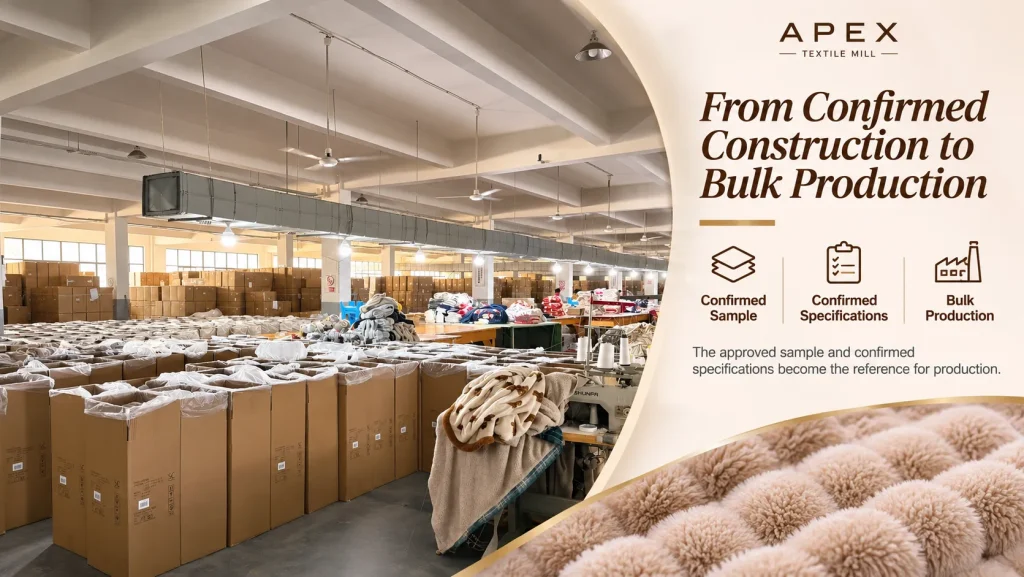
Once the sample direction is approved, the key construction details should be recorded clearly.
For a bubble faux fur blanket project, the production reference should identify:
The selected single-sided or double-sided construction
Front and reverse fabric specifications
GSM of each relevant fabric piece
Finished dimensions
Target finished weight where required
Approved color reference
Sewing and finished-edge details
The final approved physical sample
For double-sided designs, it is particularly important to confirm the specifications of both bubble faux rabbit fur pieces and their finished appearance after sewing.
The important principle is simple:
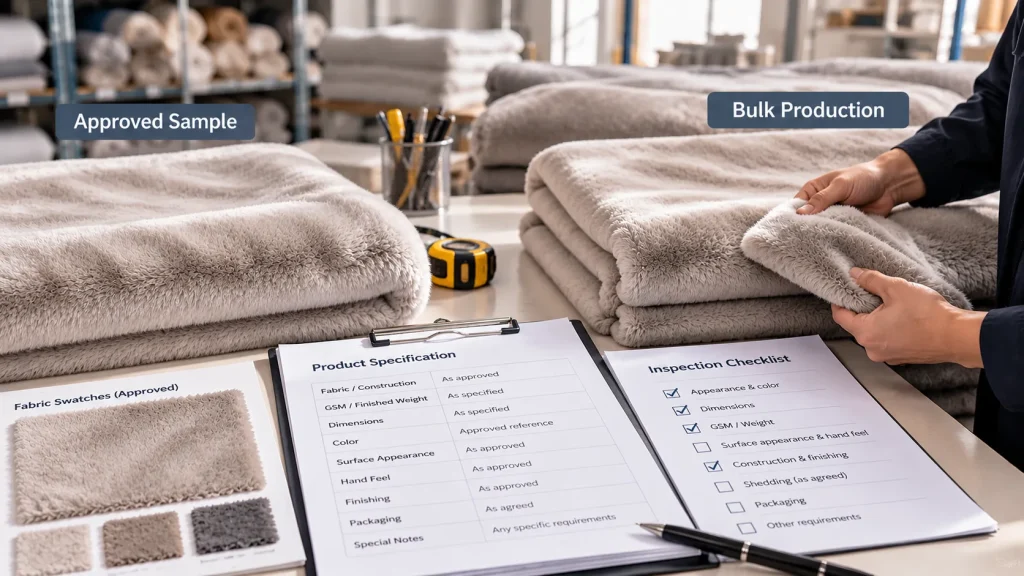
Bulk production should follow the final approved product reference, not an earlier product photograph or incomplete quotation description.
At Apex Textile Mill, approved samples and confirmed product specifications provide important references when preparing for production.
Where broader quality-control procedures are required, inspection arrangements can then be defined according to the specific product and order requirements.
6. What Should Buyers Look for in a Bubble Faux Fur Blanket Manufacturer?
Choosing a Bubble Faux Fur Blanket Manufacturer involves more than finding an attractive product image or the lowest initial quotation.
For an OEM, ODM, or private-label project, buyers should consider whether the manufacturer can clearly discuss the relationship between construction, material selection, specifications, sampling, and bulk production.
A suitable supplier should be able to help clarify:
Whether a single-sided or double-sided construction fits the product concept
Which front and reverse fabrics are suitable
How to define GSM and finished-product requirements
How to develop and evaluate a physical sample
How to confirm sewing and finished-edge details
How to arrange private-label and packaging requirements before production
For double-sided bubble faux fur blankets, the manufacturer should also be able to discuss how two pieces of fabric can be matched in terms of color, texture, thickness, and finished appearance.
The supplier should be able to explain why two visually similar blankets may not be technically equivalent.
That ability becomes particularly important when buyers are comparing quotations from multiple manufacturers.
As a China-based home textile manufacturer, Apex Textile Mill works with international brands, wholesalers, and importers on blanket development and OEM/ODM projects.
For bubble faux rabbit fur blanket programs, buyers can discuss construction options, fabric combinations, specifications, sample development, and private-label requirements with our team.
Choosing the Right Construction for Your Collection
Choosing between single-sided and double-sided bubble faux rabbit fur is not simply a question of which blanket looks more luxurious.
It is a product-development decision involving:
Fabric arrangement → Specifications → Finished weight → Cost → Market positioning
A single-sided construction provides flexibility in reverse-fabric selection.
A double-sided construction combines two pieces of bubble faux rabbit fur fabric to create a bubble-textured surface on both sides.
The right choice is the construction that creates the finished product your collection actually requires.
If you are developing a new Custom Bubble Faux Fur Blanket, defining these details before requesting final quotations or approving samples can make the sourcing process clearer and reduce unnecessary specification changes later.
Planning a Bubble Faux Fur Blanket Project?
Share your preferred construction, dimensions, target specifications, estimated order quantity, and private-label requirements with Apex Textile Mill.Our team can discuss suitable single-sided or double-sided development directions before sampling and bulk production.
Frequently Asked Questions
A single-sided bubble faux fur blanket uses bubble faux rabbit fur on the front and a selected complementary fabric on the reverse. A double-sided bubble faux fur blanket combines two pieces of bubble faux rabbit fur fabric, with the bubble-textured surface visible on both sides. The appropriate choice depends on the intended design, hand feel, finished weight, target cost, and product positioning.
Not necessarily. Finished blanket weight depends on fabric GSM, finished dimensions, construction, and the specifications of the materials used on both sides. Buyers should compare actual fabric specifications and finished product weight rather than assuming weight from the construction name alone.
Both constructions can be developed for wholesale projects. A single-sided design may provide more flexibility in reverse-fabric and cost positioning, while a double-sided design may be more suitable when the bubble texture is intended to appear on both surfaces. The final choice should be based on the target product specifications and market positioning.
Buyers should review the bubble-textured appearance, front and reverse fabric combination, thickness, hand feel, finished dimensions, finished product weight, sewing, and finished edges. For double-sided designs, the color and bubble texture of both fabric pieces should also be checked after sewing. Additional performance or quality requirements should be evaluated according to agreed methods and criteria.
Yes. Apex Textile Mill works with buyers on OEM and ODM blanket projects. Single-sided and double-sided construction options, fabric specifications, dimensions, sample development, private-label requirements, and packaging can be discussed according to the project and available production capabilities.