Choosing a blanket manufacturer for a bulk order is rarely as simple as comparing three samples and three quotations.
Imagine a U.S. buyer comparing blanket samples from three different factories.
One supplier offers the lowest price. Another has extensive experience with similar products. The third produces the best hand feel.
All three samples look good.
So which blanket manufacturer should receive the bulk order?
The answer is not necessarily the factory with the lowest quotation or even the best-looking sample.
A buyer is not really choosing between three blankets. They are choosing between three different production systems.
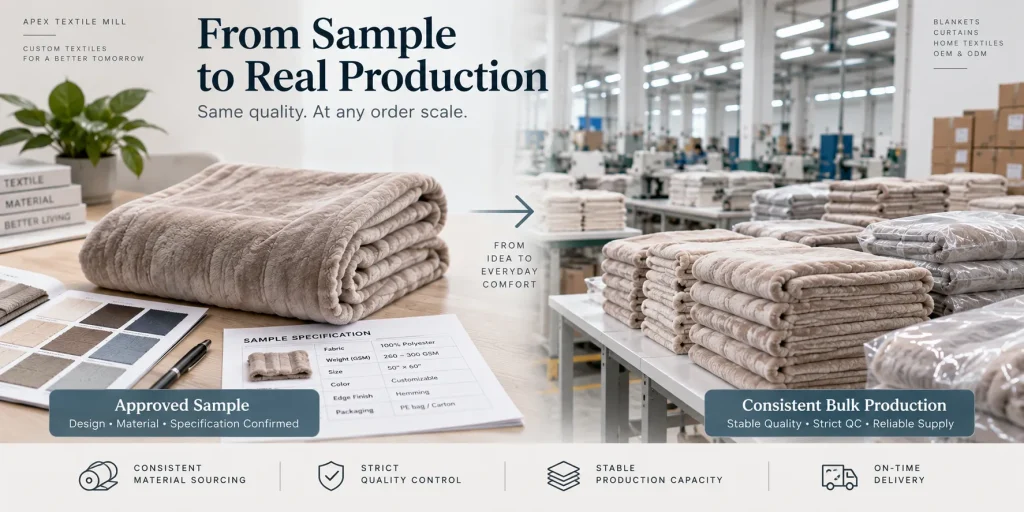
A sample proves that a manufacturer can produce a particular result once. A bulk order tests whether the manufacturer can reproduce that result consistently across thousands of units.
That difference is one of the most important things to evaluate before placing a blanket production order.
The Real Test Starts After the Sample
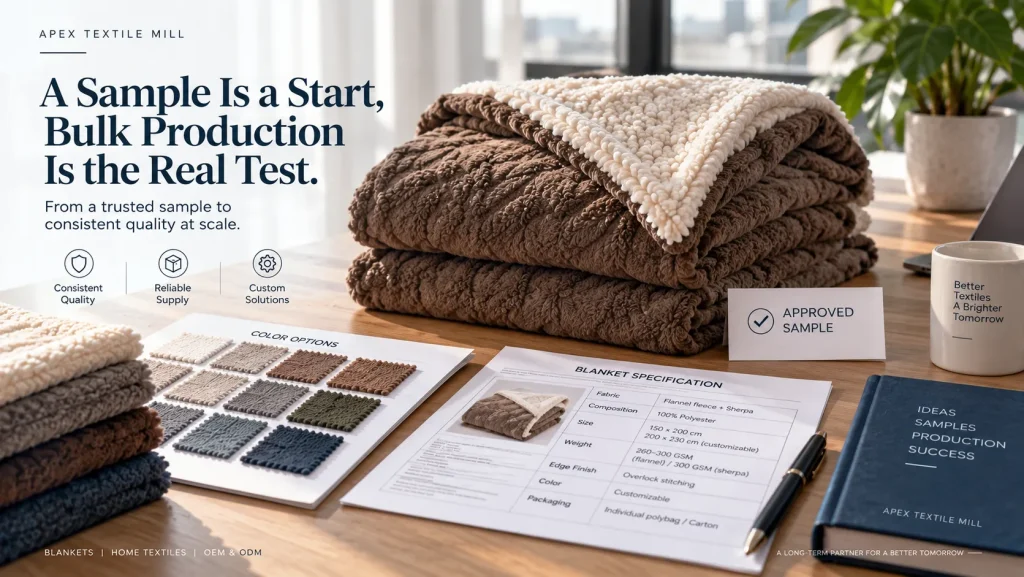
A good sample matters. It allows a buyer to evaluate the fabric, appearance, construction, hand feel, and overall suitability of the product.
But once the sample is approved, a more difficult question begins:
Can the blanket manufacturer reproduce the approved product consistently in bulk production?
The answer depends on much more than whether the factory can make a blanket.
For a private-label or wholesale blanket program, buyers may need to control:
- Fiber composition
- Fabric construction
- GSM or finished weight
- Color and shade
- Finished dimensions
- Dimensional stability and shrinkage
- Edge finishing
- Stitching and workmanship
- Print or pattern alignment
- Packaging
- Labels and private-label requirements
A sample can look excellent while still leaving important production details undefined.
The stronger question is therefore not simply:
“Can this factory make my blanket?”
It is:
“Can this factory turn this approved sample into a repeatable production standard?”
1. Confirm That the Manufacturer Can Actually Build Your Product
A manufacturer may describe itself as a blanket factory, but that does not automatically mean it has the right capabilities for your specific product.
A simple solid-color fleece blanket, for example, may require a very different production process from a double-layer flannel fleece and sherpa blanket.
Before comparing quotations, make sure the supplier understands the exact product you need.
Clarify:
- Material and fiber composition
- Fabric construction
- GSM or finished weight
- Dimensions and size requirements
- Color or print
- Edge finishing
- Stitching requirements
- Packaging
- Labels and branding
- Expected order quantity
- Required production and delivery schedule
A blanket manufacturer that produces your general product category is not automatically a manufacturer that can reliably produce your specific product.
The more technically specific the product is, the more important this distinction becomes.
2. Ask How the Approved Sample Becomes a Production Standard
One of the most important questions a buyer can ask is:
What will your production team use as the approved reference when making the bulk order?
After sample approval, the product should be translated into clear production requirements.
Depending on the product, this may include:
| What to Define | What the Buyer Should Clarify |
| Fabric | Composition and construction |
| Weight | GSM / finished weight / tolerance |
| Size | Finished dimensions / tolerance |
| Color | Approved color standard |
| Construction | Layers / stitching / assembly |
| Edge finish | Hemming / binding / finishing method |
| Packaging | Folding / bagging / carton requirements |
| Labeling | Brand / care / packaging labels |
The factory may use a specification sheet, approved sample, golden sample, material reference, color standard, or a combination of these.
The important point is that the production team should not be relying on a vague understanding of what the buyer approved several weeks earlier.
A buyer can therefore ask:
- Is there an approved specification sheet?
- Is there a physical reference sample?
- How are fabric weight and size tolerances defined?
- How is color consistency checked?
- Are packaging and labeling requirements documented?
- What inspection requirements apply to the finished product?
The objective is not to demand confidential factory information.
It is to see whether the supplier can explain clearly how your approved product becomes a controlled production standard.
3. Evaluate What Happens During Bulk Production
The difference between a sample and a bulk order becomes much clearer when the order reaches production scale.
Consider a 5,000-piece blanket order.
If a problem appears on one sample, the manufacturer can simply make another sample.
If the same problem appears across hundreds or thousands of finished blankets, the consequences are very different.
The factory may need to:
- Stop or adjust production
- Rework products
- Inspect additional units
- Repack finished goods
- Replace non-conforming materials
- Delay shipment
- Coordinate additional logistics
For the buyer, the impact can extend beyond the factory.
A production problem may affect warehouse schedules, freight arrangements, retailer delivery windows, launch dates, or selling opportunities.
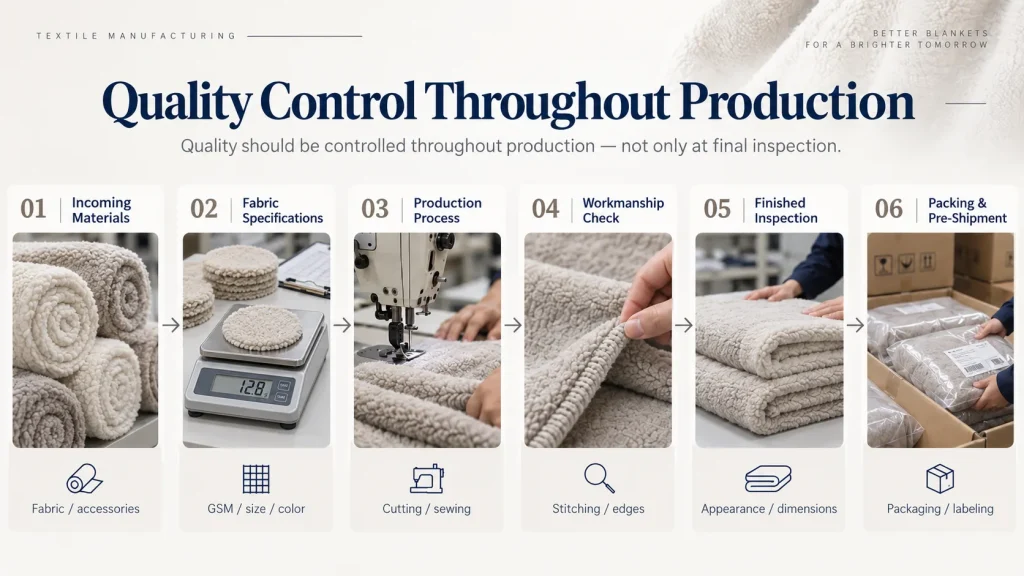
That is why buyers should ask not only whether a factory has quality control, but where quality is controlled during the production process.
Useful questions include:
- How are incoming materials checked?
- How are fabric weight and dimensions monitored?
- When are workmanship issues identified?
- How are problems handled during production?
- Who checks finished goods before packing?
- What happens when production does not match the approved standard?
The goal is to understand whether quality is built into the production process or checked only after everything has already been made.
4. Look Beyond Final QC: Evaluate Problem Management
A reliable blanket supplier is not necessarily one that claims to have no problems.
Manufacturing is a process, and problems can occur even in experienced factories.
What matters is how the supplier responds when something does not go according to plan.
A strong production system should be able to:
- Identify the problem
- Contain affected products
- Determine the cause
- Correct the issue
- Prevent the same problem from recurring
For example, if a batch of blankets has a dimensional issue, the buyer should understand whether the supplier can identify the affected production, isolate non-conforming goods, determine why the problem occurred, and decide what corrective action is required.
Before placing a bulk order, buyers can ask:
- How are non-conforming products identified and isolated?
- Who decides whether production can continue?
- How are corrective actions communicated?
- How is the root cause investigated?
- How does the factory prevent the same issue from recurring?
This gives a much clearer picture of supplier reliability than simply asking whether the factory has quality control.
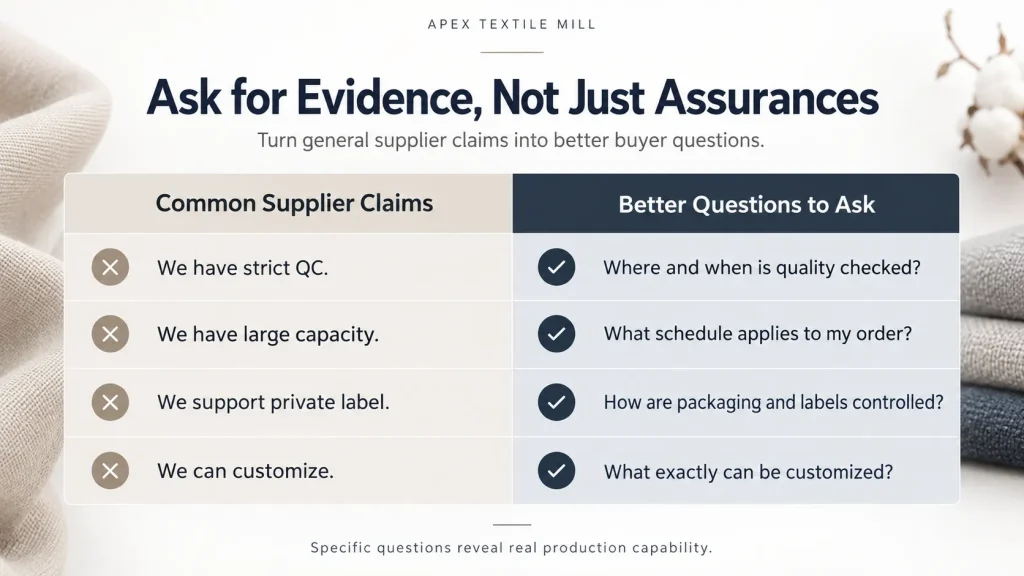
5. Ask for Evidence, Not Just Assurances
Most manufacturers can describe themselves using positive terms:
Strict quality control.
Advanced equipment.
Experienced workers.
Large production capacity.
These statements may be true. But they do not necessarily tell a buyer how the factory will perform on a specific order.
Instead of asking only what the supplier can do, ask how that capability will apply to your product.
| Supplier Claim | What the Buyer Can Ask |
| “We have strict QC.” | Where and when is quality checked during production? |
| “We have large capacity.” | What production schedule would apply to this order? |
| “We have experienced workers.” | How is the approved sample communicated to production? |
| “We can make custom products.” | Which parts of this specific product can you customize? |
| “We can meet your quality requirements.” | Which specifications and tolerances will be recorded? |
| “We support private label.” | How will packaging and labeling requirements be controlled? |
This does not mean a buyer needs access to confidential factory information.
The purpose is simply to distinguish a general sales statement from an actual production process.
A capable supplier should be able to explain how its systems apply to the buyer’s particular product.
6. Watch for Red Flags Before Placing the Bulk Order
Some warning signs are easier to identify before production begins.
6.1 The blanket supplier agrees to everything immediately
If a supplier says yes to every material, construction, MOQ, packaging, price, and lead-time requirement without first discussing production feasibility, it may indicate that the order has not been properly evaluated.
A capable manufacturer will often ask questions before confirming whether a requirement is feasible.
6.2 The approved sample has no clear production reference
If the sample is approved but there is no clear explanation of how the production team will use it as a reference, the risk of variation increases.
6.3 Quality is discussed only at final inspection
Final inspection is important, but it cannot replace process control.
If quality is checked only after production is complete, correcting a large-scale problem may already be expensive.
6.4 Capacity is expressed only as a large annual number
A factory may have substantial annual production capacity.
But annual capacity does not automatically answer whether your particular order can be produced within your required production window.
Ask about the production schedule for your actual order instead.
6.5 Problems are treated as someone else’s responsibility
If a supplier’s response to a production problem is consistently focused on why the buyer, material supplier, or shipping company is responsible, that is worth paying attention to.
The better question is whether the supplier takes responsibility for identifying and managing the problem within its own production process.
7. What Should a U.S. Buyer Ask Before Placing the PO?
Before placing a purchase order, a buyer can use the following questions to evaluate whether a blanket manufacturer is prepared for the actual production requirements.
7.1 Product
- Can you manufacture this exact blanket construction?
- What materials and fabric specifications will be used?
- How will GSM, dimensions, color, and workmanship requirements be defined?
- Can you support the required packaging and private-label specifications?
7.2 Sample-to-Bulk
- What becomes the approved production reference?
- Is there a specification sheet or golden sample?
- How are tolerances defined?
- How are changes after sample approval documented?
7.3 Production
- What production schedule would apply to this order?
- What production capacity is available during the required period?
- Where are quality checks performed during production?
- How are production changes or unexpected problems handled?
7.4 Quality
- How are incoming materials checked?
- How are defects identified during production?
- How are non-conforming products isolated?
- What happens if the finished product does not meet the approved standard?
7.5 Packaging and Labeling
- How are packaging requirements documented?
- How are brand and care labels controlled?
- Will the finished packing method match the approved specification?
7.6 Communication
- Who is responsible for communicating production issues?
- How are changes approved?
- How quickly will the buyer be informed if a problem may affect delivery or product quality?
These questions do not require a buyer to understand every detail of textile manufacturing.
They help reveal whether the supplier has a structured process for turning specifications into finished products.
8. What This Looks Like in a Real Blanket Manufacturing Program
For a custom blanket program, production control becomes especially important when several specifications interact.
Take a double-layer blanket as an example.
The two fabric surfaces may have different characteristics. Their individual weights, construction methods, dimensions, edge finishing, stitching, and final assembly all affect the finished product.
For OEM and private-label orders, the production process may also need to incorporate custom colors, sizes, labels, packaging, and other brand requirements.
This is where manufacturing experience becomes more meaningful than a simple product catalog.
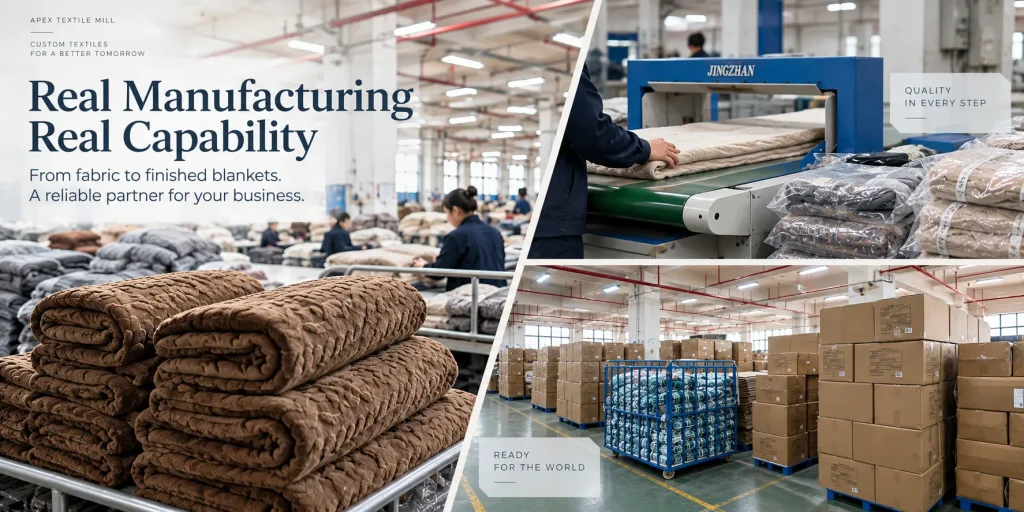
At Apex Textile Mill, home textile manufacturing experience dates back to 2007. Today, the company operates across approximately 50,000 m² of combined production area, employs more than 350 people, and provides OEM manufacturing services to customers across the United States, Europe, Japan, and South Korea.
The value of these numbers is not simply scale.
For a buyer, the more important question is whether manufacturing experience can support the process described above: understanding the product, translating an approved sample into production requirements, managing bulk production, controlling quality, and responding when something needs to change.
That is the standard a manufacturer should be evaluated against.
The Difference Between a Factory That Can Make Your Product and One That Can Support Your Program
The first order is often only the beginning.
A successful blanket program may later require:
- A new color
- A different size
- A heavier or lighter GSM
- A revised edge finish
- New packaging
- New labeling
- A different construction
- A different order quantity
A supplier that can make one approved sample is useful.
A supplier that can support these changes while maintaining production consistency is much more valuable.
This is particularly important for brands, retailers, wholesalers, and importers building repeat programs rather than placing one-time orders.
The right question is therefore not only:
“Can this factory make my blanket?”
It is:
“Can this manufacturer support the product as the program develops?”
A Practical Buyer Summary
Before choosing a blanket manufacturer, a buyer should be able to answer six basic questions:
| Area | Buyer Should Confirm |
| Product fit | Can the factory manufacture this exact construction? |
| Production reference | Is the approved sample translated into documented specifications? |
| Bulk control | Where is quality checked during production? |
| Problem handling | How are defects contained and corrected? |
| Order execution | Can production, packaging, and shipment meet the required program? |
| Future support | Can the supplier support repeat and revised orders? |
If these questions cannot be answered clearly, the buyer may not yet have enough information to choose the right manufacturer.
Conclusion: The Sample Is Only the Beginning
A good blanket sample can open the door to a supplier relationship.
But the bulk order is where the manufacturer has to prove that the product can be reproduced consistently, at the required scale, with the required quality and within the required production schedule.
That is why the best supplier is not necessarily the one with the lowest quotation or the most impressive sample.
It is the manufacturer that can connect product capability, production standards, quality control, problem management, communication, and long-term flexibility into one reliable production system.
The sample is where the relationship begins. Bulk production is where the manufacturer proves whether it was the right choice.
Frequently Asked Questions
Look for more than a good sample or a competitive quotation. A reliable blanket manufacturer should be able to demonstrate the right product capabilities, a clear sample approval process, consistent quality control, sufficient production capacity, a realistic production schedule, and effective communication. The key question is whether the manufacturer can reproduce the approved product consistently throughout bulk production.
Ask about the production capacity available for your specific order and required production window, rather than relying only on the factory’s total annual capacity. A blanket factory should be able to explain how your order will be scheduled, when production can begin, and whether the required quantity can be completed within your target timeframe. This gives a more realistic view of whether the factory can support your order.
Before bulk production begins, confirm that the approved sample is supported by clear production specifications. These may include fabric composition, GSM, dimensions, color standards, construction, finishing, packaging, and labeling requirements. The blanket supplier should have a clear reference—such as an approved sample, specification sheet, or golden sample—to help the production team reproduce the agreed product consistently.
A capable blanket supplier should control quality throughout the production process rather than relying only on final inspection. Buyers can ask how incoming materials are checked, how fabric weight and dimensions are monitored, how workmanship issues are identified, and how non-conforming products are isolated and corrected. The goal is to understand where and how quality control takes place before the finished goods are shipped.
A capable blanket manufacturer should be able to identify the problem, contain affected products, determine the cause, implement corrective action, and prevent the same issue from recurring. Buyers should also understand who is responsible for communicating production problems and how the supplier will respond if an issue could affect product quality or the production schedule.
Before placing an order, confirm the manufacturer’s MOQ, expected sample and bulk production lead times, and the production schedule for your specific order. It is also useful to ask whether MOQ or lead time changes for custom materials, special constructions, private-label packaging, or different order quantities. Clear expectations at this stage can help prevent production or delivery problems later.