For a small brand, planning a first custom blanket order means more than negotiating a lower MOQ.
A buyer also needs to understand what is creating the minimum quantity, which costs occur before production, which product features are essential, and where flexibility may reduce the commercial commitment without weakening the product itself.
Consider an emerging brand preparing to launch its first custom blanket.
The product idea is already fairly clear. The brand knows the hand feel it wants, has a reference product, and has a limited amount of capital available for the first launch.
But there is one problem.
The buyer would prefer to begin with around 200 pieces.
The proposed blanket, however, requires a larger production commitment.
At that point, the real question is no longer simply:
“Can the factory lower the MOQ?”
A more useful question is:
“What is driving the MOQ, and is there another production route that still gives me the product I actually want?”
That distinction matters.
A well-planned first order is not necessarily the smallest possible order. It is one where the buyer understands the product requirements, development costs, production constraints and inventory exposure before committing capital.
The following scenario is a composite based on common first-order planning discussions in custom blanket manufacturing. It does not represent a single Apex Textile Mill customer order.
1. Why Is the MOQ Higher Than the Buyer Expected?
A product idea does not automatically translate into a particular production quantity.
The minimum order quantity for a custom blanket can be influenced by several parts of the manufacturing process – and the finished-piece quantity is only one of them.
For example, a blanket based on an existing fabric, standard color and established construction may follow a relatively straightforward production route.
A different product may require:
- a custom-dyed material;
- a new surface effect;
- a pattern-specific production setup;
- a specialized construction;
- new sampling and development;
- custom labels or packaging.
Each requirement can introduce its own minimum batch or setup condition.
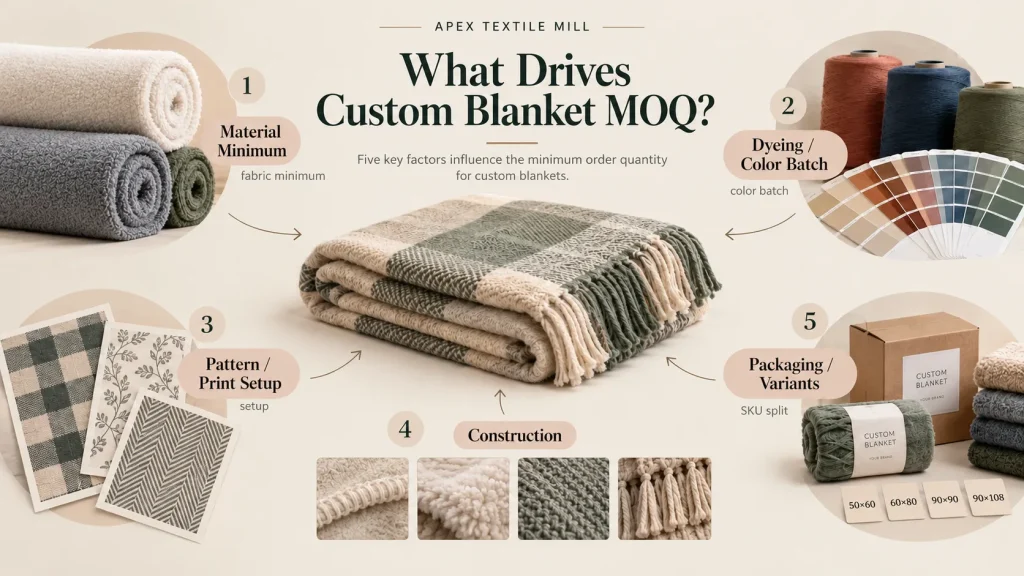
What can determine a custom blanket MOQ?
| Production factor | How it may affect the order |
| Fabric or yarn sourcing | The material itself may have a minimum purchase quantity |
| Dyeing / color | A production color may require a minimum dyeing batch |
| Pattern or print | Custom patterns may require a separate production minimum |
| Construction | Certain structures require a specific setup or production run |
| Finished size | Larger or unusual dimensions affect material consumption |
| Packaging | Custom retail packaging may have its own supplier MOQ |
| Number of variants | Splitting an order across multiple colors or sizes can reduce the quantity in each individual run |
This means a buyer asking for 200 finished blankets may not actually be facing a “200-piece problem.”
The real limitation might be the amount of fabric required for a production color, the batch size needed for a particular process, or the quantity required to run a specific construction efficiently.
For some standard Apex fleece blanket programs, finished-product quantities may begin around 500-1,000 pieces, depending on size and specification. But this should not be treated as a blanket-wide MOQ. Different materials, colors, constructions, print requirements and custom developments can create very different minimums.
The better question is therefore:
“What specifically is driving the MOQ for this product?”
Once that is understood, the buyer has something useful to evaluate.
2. MOQ and Development Cost Are Not the Same Thing
A lower minimum order quantity does not automatically mean a lower initial investment.
This is one of the most important distinctions for a brand planning its first custom product.
MOQ describes the minimum commercial production quantity under a particular set of manufacturing conditions.
Development costs are different.
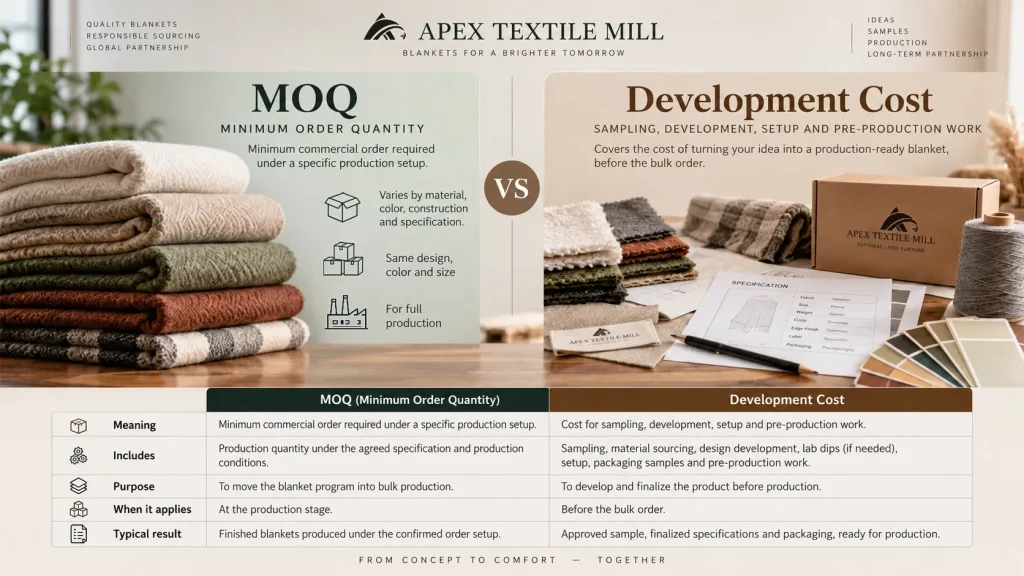
Depending on the project, they may include:
- sample development;
- revised samples;
- custom material or color development;
- pattern-specific setup;
- specialized tooling where genuinely required;
- packaging development;
- other one-time pre-production work.
A product with a relatively low finished-piece MOQ may still require substantial upfront development.
At the same time, a product using an existing fabric, color, construction and packaging route may require less development even if the production quantity itself is not dramatically smaller.
Before comparing suppliers, separate these numbers:
| Cost or requirement | What the buyer is actually paying for |
| Production MOQ | The minimum quantity of finished production |
| Sample fee | Development or approval samples |
| Development cost | Work required to establish a new product specification |
| Production setup | Preparation before manufacturing begins |
| Material minimum | Minimum fabric, yarn or color-batch requirement |
| Custom packaging MOQ | Minimum quantity required by the packaging supplier |
| Unit price | Cost applied to the finished production quantity |
So the correct comparison is not simply:
“Which manufacturer offers the lowest MOQ?”
It is:
“What is my total commitment to get this product into production?”
That is the number that matters to the buyer’s cash flow.
3. What If the Original Product Does Not Fit the First Order?
Suppose the buyer’s original blanket specification creates a production minimum that is higher than expected.
There are several possible responses.
One is to accept the original requirement and increase the order.
Another is to abandon the product.
But there is often a third question worth exploring first:
“Is there a practical alternative that preserves the core product idea?”
For example, suppose the original request uses coral fleece, but its material or color requirements do not fit the intended first-order quantity.
A manufacturer may be able to evaluate an existing dense short-pile polyester plush construction – sometimes commercially described by suppliers as milk velvet – as an alternative.
That does not mean the buyer should automatically switch materials.
The two products still need to be evaluated.
The buyer should compare:
- fiber composition;
- GSM;
- hand feel;
- surface appearance;
- drape;
- required performance;
- revised MOQ;
- quotation;
- production schedule;
- overall brand positioning.
If the alternative changes the feature that made the product attractive in the first place, then the lower commercial commitment is not worth it.
If it maintains the essential product experience while providing a more practical manufacturing route, it may deserve consideration.
A material change does not automatically guarantee:
a lower MOQ
a lower price
or
a shorter lead time.
It simply creates another route to evaluate.
4. Decide What Is Essential – and What Is Flexible
This is where the first-order discussion becomes much more useful.
Instead of treating every specification as equally fixed, the buyer can separate the product into two groups.
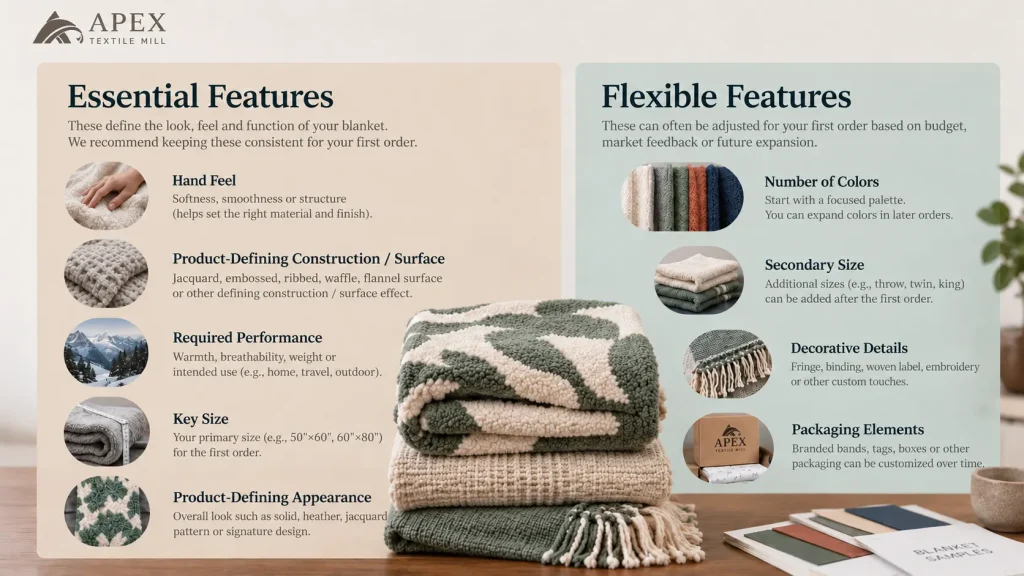
Essential Features
These are the characteristics that define the product.
Depending on the blanket, they might include:
- the core hand feel;
- required fabric performance;
- a product-defining texture or construction;
- a specific weight range;
- dimensions required for the intended market;
- an appearance that is central to the brand concept.
These are the features the buyer should be cautious about compromising.
Flexible Features
Other decisions may have more room for adjustment.
Depending on the project, these could include:
- the number of initial colors;
- a secondary size;
- selected decorative details;
- nonessential finishing;
- certain packaging elements;
- details that could be introduced in a later collection.
This distinction gives the manufacturer something useful to work with.
Instead of hearing:
“I need exactly this product, but I need a much lower MOQ,”
the manufacturing discussion becomes:
“These features define the product. Which other parts of the specification could change if we need a more practical first-order route?”
That is a much more realistic sourcing conversation.
5. Keep the First Collection Focused
The same principle applies to the collection itself.
A new brand may initially want:
four colors,
three sizes,
two patterns,
and several packaging variations.
From a branding perspective, that can feel like a stronger launch.
Commercially, however, every additional SKU creates another demand forecast and another inventory commitment.
It may also interact with manufacturing minimums.
For example, reducing the number of colors can make inventory easier to manage.
But it does not automatically reduce the production MOQ.
If each color is subject to a material or dyeing batch requirement, the relationship between color count and MOQ has to be evaluated for that specific product.
A more focused first collection might therefore begin with:
“one core product + a carefully selected color range”
and expand after the brand has gathered real market feedback.
This can reduce:
- inventory fragmentation;
- forecasting complexity;
- slow-moving variants;
- working capital tied up in untested SKUs.
The objective is not to strip the product down until it becomes generic.
It is to avoid investing heavily in variations that have not yet demonstrated demand.
6. What Should the Buyer Do When the Numbers Still Do Not Work?
At this stage, the buyer should have a much clearer picture.
The original target quantity may still be below the production requirement.
But instead of seeing only one obstacle – “the MOQ is too high” – the buyer now knows why.
That creates three practical routes.
Route A – Keep the Original Product
Retain the preferred material, construction and design, then understand the actual production commitment.
If those features are essential to the brand proposition, accepting the higher quantity may be the correct decision.
Route B – Evaluate a Suitable Alternative
Review whether an existing material, color, construction or selected design adjustment can reduce unnecessary development or create a more practical production route.
The alternative should only be accepted if the finished product still meets the buyer’s essential requirements.
Route C – Change the First-Order Plan
If neither the original specification nor the available alternatives fit the intended investment, the buyer may need to reconsider:
- the quantity;
- the number of colors;
- the number of sizes;
- the collection scope;
- the timing of the launch.
There is no rule that says every custom blanket concept must be forced into a very small first order.
And there is no rule that says the buyer should automatically increase the order simply because the factory has a higher MOQ.
The correct decision depends on the product and the commercial plan.
7. How Apex Textile Mill Approaches a First Custom Blanket Order
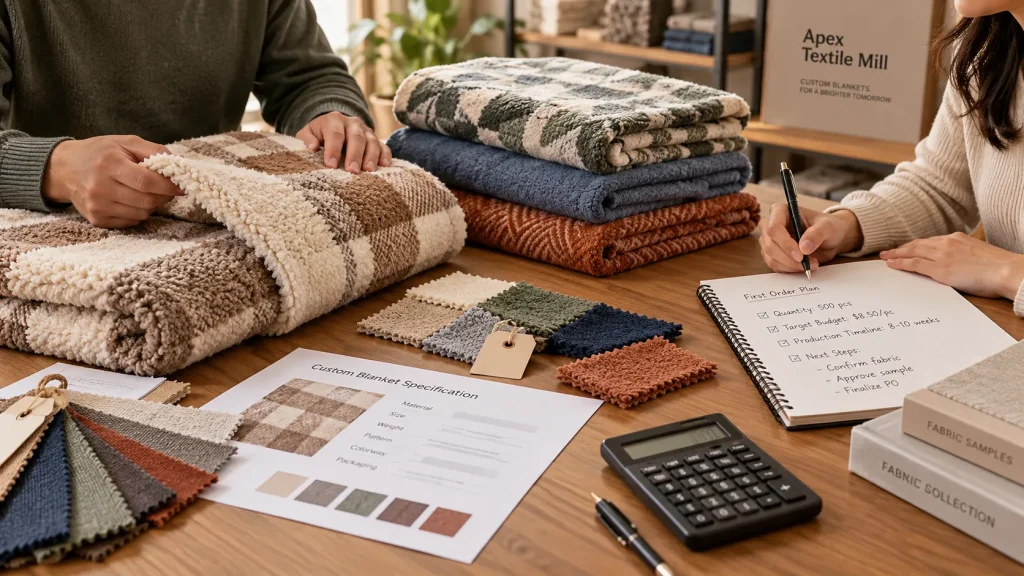
At Apex Textile Mill, an early-stage discussion can begin before every specification is finalized.
A buyer can share:
- reference images or a physical sample;
- preferred fabric or hand feel;
- approximate size;
- intended market;
- target quantity;
- required customization;
- budget or target price;
- the features that matter most to the product.
From there, the discussion can focus on the actual manufacturing requirements behind the idea.
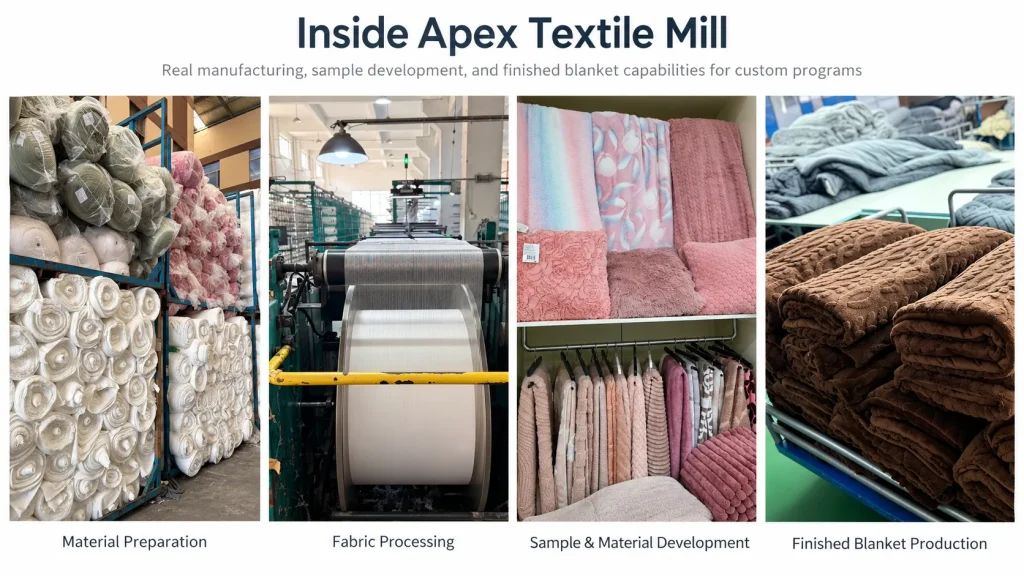
If the target quantity does not fit the original specification, the objective is not simply to say:
“Your MOQ is too low.”
Nor is it to promise that every MOQ can be reduced.
Instead, the useful questions are:
“What is causing the production minimum?”
“Which requirements should remain unchanged?”
“Is there an existing material or production route worth evaluating?”
“Would changing a flexible feature materially improve the first-order economics?”
“If not, does the order plan itself need to change?”
Not every project has a lower-quantity solution.
Some products genuinely require a larger material or production commitment.
A useful manufacturer should make that constraint understandable before the buyer commits to production.
Plan the First Order Around an Informed Decision
A first custom blanket order does not have to be the smallest order possible.
It does not have to be the simplest product either.
A strong first order is one where the buyer understands:
- what defines the product,
- what is driving the MOQ,
- what development costs occur before production,
- where flexibility is possible,
- how much inventory and working capital the launch will actually require.
That gives the brand a better basis for deciding where to protect the original idea, where to adjust, and when a larger production commitment genuinely makes commercial sense.
The objective is not simply to lower the MOQ.
It is to make the first commitment deliberately.
Frequently Asked Questions
A custom blanket MOQ can be affected by material sourcing, dyeing or color-batch requirements, construction, printing or pattern requirements, size, production setup, packaging and how the total quantity is divided across colors or sizes. Buyers should ask what specifically is driving the MOQ for their product rather than assuming the number is fixed across all blankets.
Ask the manufacturer to explain the source of the constraint first. If the minimum is driven by material, color, construction or production setup, it may be possible to evaluate an existing material, adjust a flexible specification, reduce the number of variants or reconsider the launch plan. A smaller quantity is not always feasible, but understanding the reason behind the MOQ gives the buyer meaningful options.
No. A lower MOQ may reduce finished inventory, but development, sampling, material minimums, production setup or custom packaging can still create significant upfront costs. Buyers should compare total initial commitment rather than MOQ alone.
Sometimes, but not automatically. The alternative must still meet the required hand feel, appearance, performance and brand positioning. It should also be compared for composition, GSM, price, MOQ and production requirements before the specification is changed.
It depends on the production route. Fewer colors can simplify inventory planning, but each color may still be subject to material or dyeing minimums. The effect should be confirmed for the specific fabric and manufacturing process.
A useful starting brief includes a reference image or sample, preferred material or hand feel, approximate size, intended market, target quantity, customization requirements, target price or budget and any features that are essential to the product. If some requirements are flexible, explain that as well.
Planning Your First Custom Blanket Order?
Send Apex Textile Mill your reference image or sample, preferred material or hand feel, size, target quantity, intended market and target budget.
We can review which requirements may affect the MOQ, where flexibility may exist, and which production route is practical for your project.