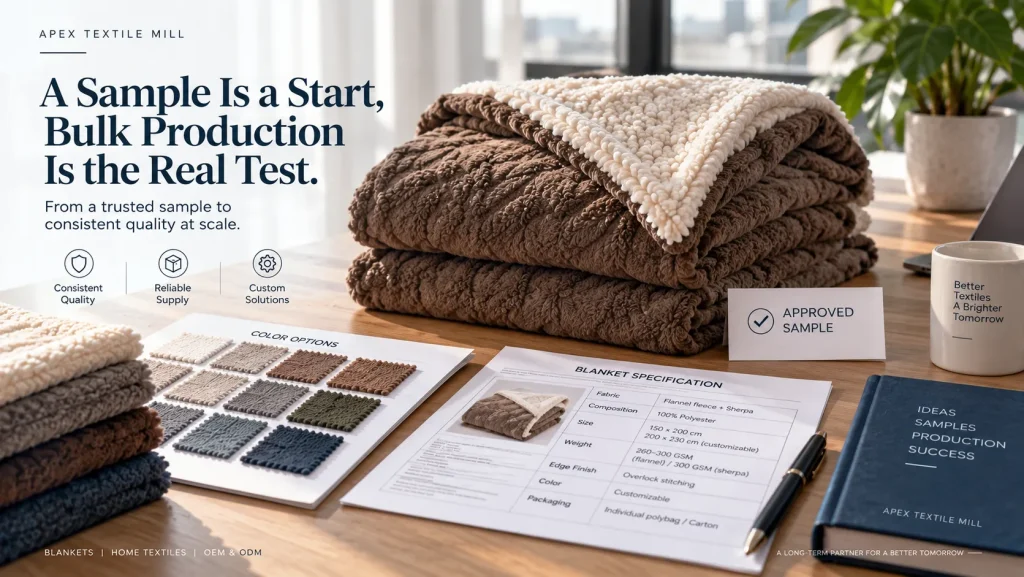
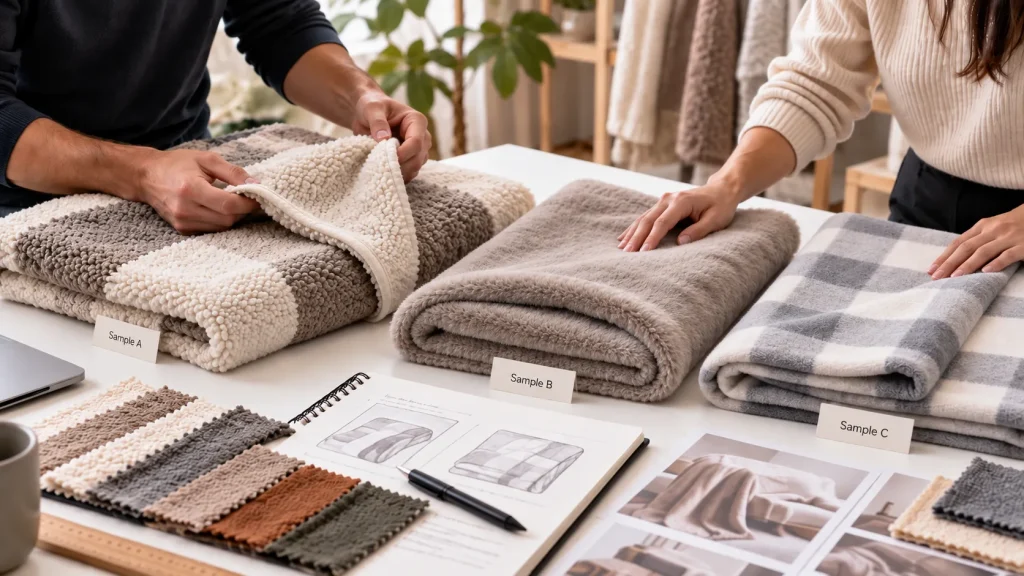
Custom blanket development often begins by comparing reference samples, materials, textures and construction directions.
The following is a composite scenario based on common custom blanket development projects. It does not represent a single customer order.
A buyer does not always approach a custom blanket manufacturer with a finished tech pack or complete product specification.
Sometimes the starting point is much simpler.
A brand may have a reference blanket, a product image, a target retail position, an approximate price, and a clear idea of how the finished product should feel.
The buyer may say:
“I want something softer and more substantial than a standard fleece blanket, with a more premium surface – but I do not want the product to become too heavy or push the target price too high.”
That is already useful product direction.
But it is not yet a manufacturing specification.
The role of a custom blanket manufacturer is to help translate those commercial and sensory requirements into measurable product decisions – such as material, fabric construction, GSM, dimensions, finishing, labeling and packaging – and then validate those decisions through sample development.
The objective is not simply to create a sample the buyer likes.
It is to arrive at a product definition that can actually be manufactured.
1. The Buyer Knows What the Product Should Feel Like. The Manufacturer Has to Determine How to Build It.
Consider a buyer developing a new blanket collection.
The buyer already has a reference blanket and likes its soft hand feel and dimensional surface.
However, the new product needs to feel slightly more substantial without becoming unnecessarily heavy.
The request may sound simple:
“Can you make something like this, but softer, with a little more body?”
From the buyer’s perspective, the direction is clear.
From a manufacturing perspective, several questions immediately appear.
- Does “softer” require a different fabric?
- Could the surface construction be changed?
- Would additional finishing improve the hand feel?
- Does “more body” require a higher GSM?
- Could a different construction create a fuller feel without adding as much weight?
- Would changing GSM or construction push the material cost above the target?
- Would the change also increase packing volume or shipping cost?
There is rarely one automatic answer.
The manufacturer’s first task is therefore not simply to make the blanket.It is to translate the product idea into realistic manufacturing options.
2. A Product Description Is Not Yet a Product Specification
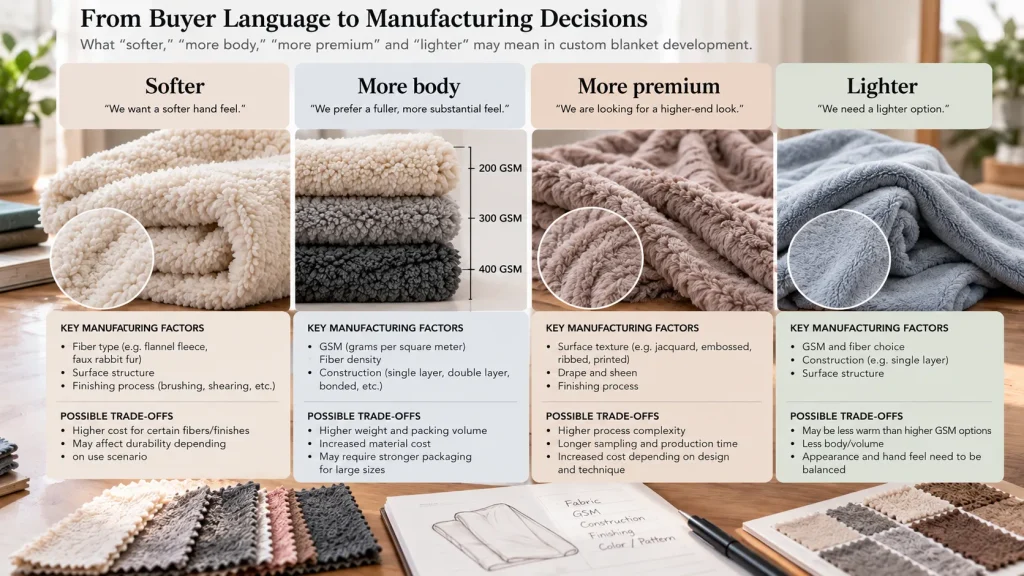
Words such as soft, substantial, premium, lightweight, plush and smooth are useful because they describe what the buyer wants the finished product to achieve.
But they are not specifications.
For a blanket manufacturer, those descriptions have to be connected to variables that can actually be developed, measured and controlled.
| What the buyer says | What the manufacturer may evaluate | Possible trade-offs |
| “I want it softer.” | Fiber, fabric construction, surface structure, finishing | Appearance, durability, cost |
| “It needs more body.” | GSM, density, construction, surface structure | Weight, material cost, packing volume |
| “It should look more premium.” | Texture, surface density, drape, finishing | Cost, process complexity |
| “I want it lighter.” | GSM, fiber choice, construction | Body, warmth, appearance |
| “I want a fuller surface.” | Fabric structure, pile characteristics, finishing | Weight, hand feel, production cost |
These variables are connected.
Increasing GSM may make a blanket feel more substantial, but it can also increase material consumption, packing volume and shipping weight.
Changing the surface construction may create a fuller appearance without requiring the same increase in GSM.
A softer finishing process may improve hand feel, but it can also influence the appearance and performance of the fabric.
This is why custom blanket development is not always a matter of selecting one fabric from a catalog.The product has to be considered as a system.
3. What Does a Buyer Need Before Contacting a Custom Blanket Manufacturer?
A buyer does not necessarily need a complete tech pack before beginning a custom blanket development project.
A clear product direction is often enough to start a useful conversation.
The more relevant information the buyer can provide, however, the easier it becomes for the manufacturer to evaluate realistic development routes.
| Helpful buyer input | Why it matters |
| Reference blanket or product image | Shows the intended hand feel, appearance, texture or construction direction |
| Target price | Helps define realistic material and manufacturing options |
| Approximate size | Influences material consumption, cost and finished construction |
| Expected order quantity | Affects material sourcing, custom-color feasibility, MOQ and development economics |
| Target market | May influence sizing, labeling, packaging and product positioning |
| Desired hand feel | Guides fabric, construction and finishing decisions |
| Preferred appearance | Helps define surface texture, density, color and drape |
| Intended use | Helps determine appropriate weight, construction and performance |
| Packaging requirements | May affect product dimensions, folding method, packing volume and final cost |
Order quantity is particularly important.
A material, custom color, construction or packaging option that is commercially practical at one order volume may not be economical at another.
The manufacturer therefore needs to understand not only what the product should be, but also how the buyer intends to commercialize it.
4. Why Manufacturing Capability Matters Before the Specification Is Finished
If a buyer already has a complete technical specification, the manufacturer’s role is relatively straightforward:
“Receive specification -> develop sample -> approve sample -> manufacture product.”
Custom OEM or ODM development may begin much earlier.
The buyer may know:
- the target customer,
- the intended market position,
- the desired hand feel,
- the approximate price,
- the intended appearance,
while some technical decisions are still open.
That requires more than finished-product manufacturing capacity.
It requires manufacturing capabilities that allow different product variables to be evaluated together.
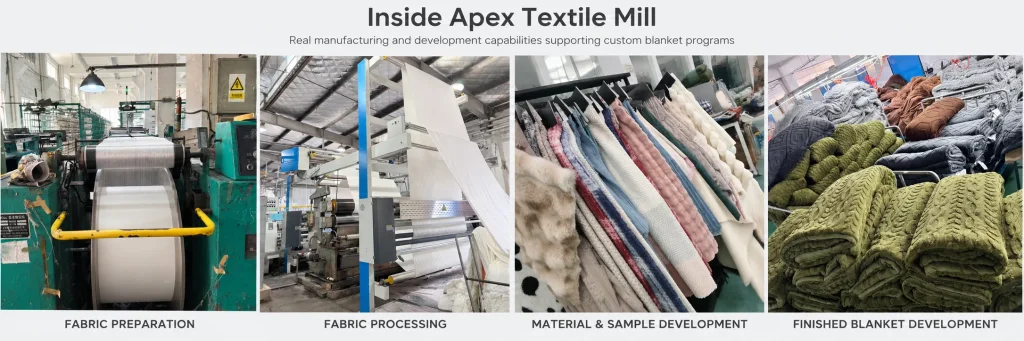
1. Material and Process Capability
At Apex Textile Mill, the manufacturing setup includes capabilities across texturizing, weaving, dyeing and finishing, alongside blanket sample development and bulk manufacturing.
These processes matter because the characteristics of a finished blanket are rarely created by one decision alone.
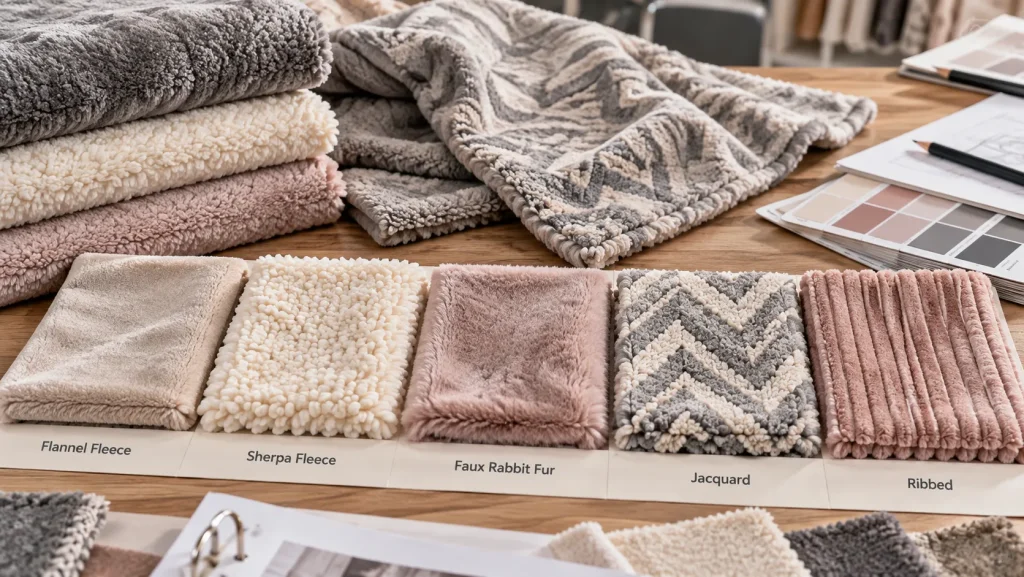
Different blanket materials and surface constructions can create very different hand feel, appearance and performance characteristics.
- Fabric construction can influence hand feel.
- GSM and density can influence weight and body.
- Texturizing and finishing can influence surface appearance and touch.
- Weaving construction can affect texture, density and dimensional characteristics.
For a buyer asking for something that feels:
“softer, but not heavier,”
a manufacturer with broader process knowledge has more than one possible route to investigate.
The solution does not automatically have to be:
“Use a higher GSM.”
2. Development and Sampling Capability
Once possible development directions have been identified, they need to be tested physically.
That is where sample development becomes important.
A specification can suggest how a blanket should perform.
A physical sample shows how those decisions actually interact.
A buyer may discover:
“The softness is right, but the blanket still needs more body.”
“The weight feels right, but the surface looks flatter than expected.”
“The texture looks premium, but the product has become too heavy for the target price.”
This feedback is far more useful than simply saying:
“Make it better.”
Each sample helps narrow the development variables.
The discussion gradually moves from subjective product language toward measurable manufacturing decisions.
3. Production Feasibility
Product development should not end with a sample that looks good.
The material, construction and finishing decisions also need to be practical for the intended order volume.
A development route that works for one development sample but cannot be controlled efficiently during manufacturing is not yet a production-ready solution.
The objective is therefore to develop a product that achieves the buyer’s intended result and can realistically move into commercial production.
For a deeper discussion of what buyers should evaluate after a sample has been approved, Apex Textile Mill’s separate guide on choosing a blanket manufacturer for bulk orders covers sample-to-bulk consistency, production control and supplier evaluation.
5. The First Sample Often Changes the Conversation
Assume the first development sample is close.
The surface feels softer than the original reference.
The overall appearance is moving in the right direction.
But when the buyer handles the blanket, something is still missing.
It feels soft.
It simply does not have enough body.
The buyer’s feedback can now become more precise:
“The softness is right. I want it to feel slightly more substantial, but I do not want it to become stiff or significantly heavier.”
This is where the value of physical sampling becomes clear.
Before the sample, “premium” or “substantial” may be subjective descriptions.
After the sample, both the buyer and manufacturer have something physical to evaluate.
The development question is no longer:
“How do we make the blanket heavier?”
It becomes:
“How do we create more body while keeping the hand feel, target price, appearance and intended product positioning under control?”
That is a manufacturing question.
It is also a product-development question.
6. Custom Blanket Development Is About Balancing Variables
There is rarely one fabric, one GSM or one construction that is automatically best for every custom blanket.
The correct choice depends on the product the buyer is trying to create.
A higher GSM may be appropriate for one blanket and unnecessary for another.
A more dimensional surface may create the fuller visual character a buyer wants without requiring the same increase in weight.
A different construction may improve hand feel more efficiently than simply adding material.
A higher GSM is not automatically a better blanket.
GSM should be evaluated together with:
- construction,
- surface density,
- hand feel,
- drape,
- intended use,
- target price,
- packaging,
- and commercial positioning.
Apex Textile Mill develops different faux-fur blanket constructions according to individual product requirements.
For example, depending on the intended construction and development target, a double-sided faux rabbit fur blanket may be developed around 400-600 GSM per side, while a double-sided spandex faux rabbit fur construction may be developed around approximately 400-650 GSM per side.
These figures are not universal standards for every faux-fur blanket.
They illustrate why product development needs to consider the entire construction rather than treating GSM as an isolated number.
Changing weight may affect:
- hand feel
- appearance
- material cost
- packing volume
- shipping
Changing composition may affect:
- stretch
- texture
- surface behavior
- performance
Changing surface structure may alter the visual character of the blanket without requiring the same change in weight.
The right specification therefore depends on what the buyer is actually trying to achieve.
7. From a Reference Blanket to a Production-Ready Specification
After discussion and several rounds of sample development, the product should no longer exist only as:
“a reference blanket + a verbal description.”
It should become a defined product.
A production-ready blanket specification may record:
- fiber composition,
- fabric type,
- GSM,
- construction,
- finished size,
- color,
- edge finish,
- labeling,
- packaging,
- and other project-specific requirements.
The approved physical sample provides one reference.
The written specification provides another.
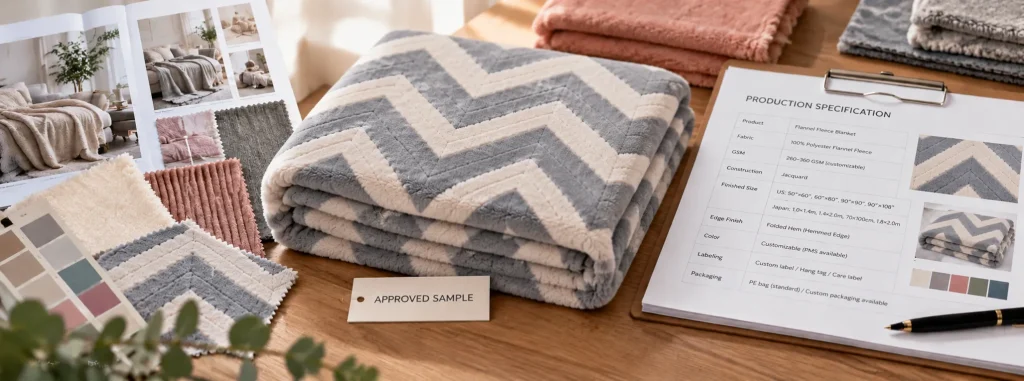
Together, they reduce the need for the production team to interpret subjective descriptions such as:
“slightly softer”
or
“a little more premium.”
The development process has converted those ideas into manufacturing decisions.
That is the real transition:
Product idea
↓
Manufacturing options
↓
Development sample
↓
Buyer feedback
↓
Sample adjustment
↓
Approved product
↓
Production-ready specification
8. The Real Output of Product Development Is Not Just the Sample
A sample is an important milestone.
But it is not the final output of a successful custom blanket development project.
The real result is a product that can be:
- described
- specified
- approved
- reproduced
- commercialized
A manufacturer’s role can therefore begin before a purchase order and before the buyer has every technical answer.
The buyer brings:
- the market requirement,
- product positioning,
- target price,
- desired appearance,
- hand-feel direction,
- and commercial objective.
The manufacturer contributes:
- material knowledge,
- manufacturing experience,
- process understanding,
- sample development,
- and technical translation.
At Apex Textile Mill, those development capabilities are connected to the manufacturing process rather than treated as a separate design exercise.
A development discussion can begin with a reference blanket, a product image, a target price, an expected order quantity, or simply an idea of how the finished blanket should feel.
From there, the product can be developed through decisions around fabric, composition, GSM, construction, texture, sizing, finishing, labeling and packaging until there is a specification that manufacturing can follow.
You do not need to arrive with every technical answer.
You need to arrive with a clear enough product direction to begin the development process.
Frequently Asked Questions
Yes. A reference blanket can provide useful information about the desired hand feel, appearance, construction direction, dimensions or performance target. The manufacturer can then evaluate suitable materials, fabric construction, GSM, texture and finishing options and develop samples around the buyer’s own product requirements.
The objective should not necessarily be to copy the reference product exactly, but to use it as a practical development reference.
Not necessarily.
A complete tech pack can make development more straightforward, but many custom blanket projects begin with less technical information.
A buyer may start with a reference product, image, target price, intended market, approximate size, expected quantity and desired hand feel.The technical specification can then be developed and confirmed through discussion and sampling.
No.
If you already have a target GSM, that can be useful.
But GSM should not be selected in isolation.
A buyer can begin with the desired hand feel, weight, appearance, target price and intended use. The appropriate GSM can then be evaluated together with material, construction, density and finishing during the development process.
In general, OEM projects begin with buyer-defined requirements or product direction, while ODM projects may involve greater manufacturer participation in developing materials, construction or other technical aspects of the product.
However, these terms are not used identically by every supplier.
Buyers should therefore confirm the actual division of development responsibilities rather than rely on the OEM or ODM label alone.
Apex Textile Mill can support development from an initial product idea, reference blanket or product image through material evaluation, fabric construction, GSM, texture, sizing, finishing and sample development.
Its manufacturing capabilities across texturizing, weaving, dyeing and finishing help connect product development decisions with the processes used to manufacture the final blanket.
The objective is to move from a buyer’s commercial product idea toward a clearly defined product that can be manufactured.
Yes.
An existing blanket or reference sample can be used to communicate characteristics such as hand feel, surface appearance, size, construction direction or performance expectations.
Apex Textile Mill can then develop a specification around the buyer’s own requirements, including material, construction, GSM, size, color, finishing, labeling and packaging.
The reference provides direction; the final specification should define the buyer’s own product.