Peter had a limited budget and a difficult decision to make. As tariffs put pressure on his purchasing costs, the U.S. blanket buyer moved half of his order volume to a factory in Vietnam. Its quotation was slightly lower than ours.
He kept the other half with Apex Textile Mill.
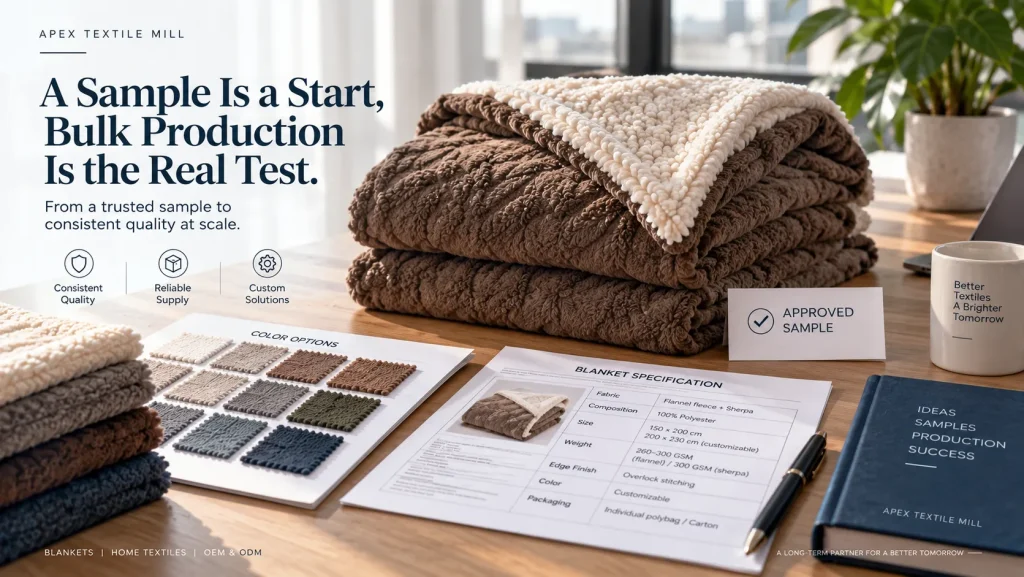
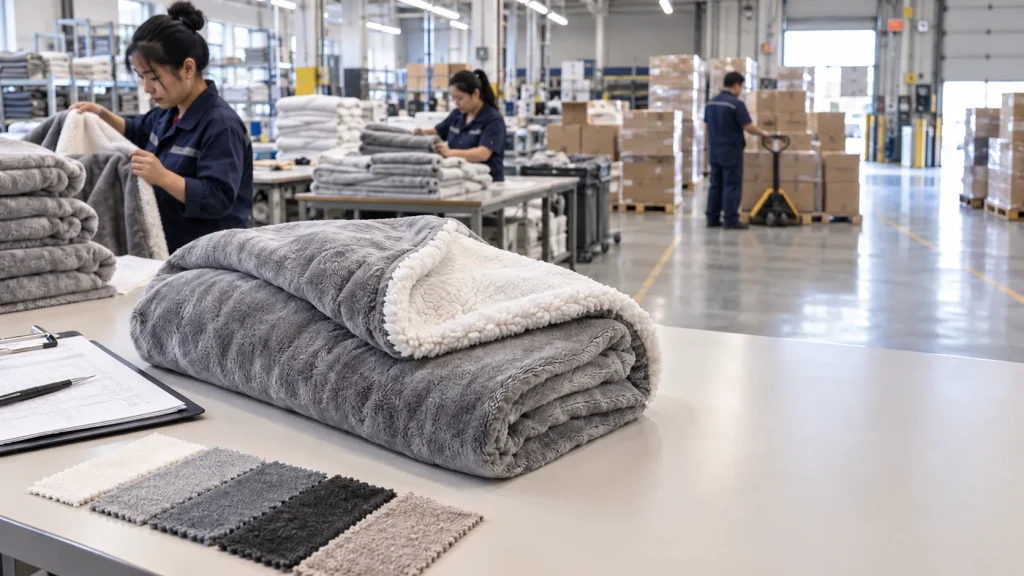
The product was a double-layer blanket with a flannel fleece face and a sherpa reverse, both made from 100% polyester. For Peter, splitting the orders offered a way to explore savings while continuing to work with an existing supplier.
At Apex, we completed and shipped our portion on schedule. The orders placed in Vietnam encountered delays—and the effects reached beyond the factory.
Peter is a pseudonym. This account paraphrases the experience and feedback he shared with Apex Textile Mill.
1. How a Lower Quotation Became a More Expensive Delivery
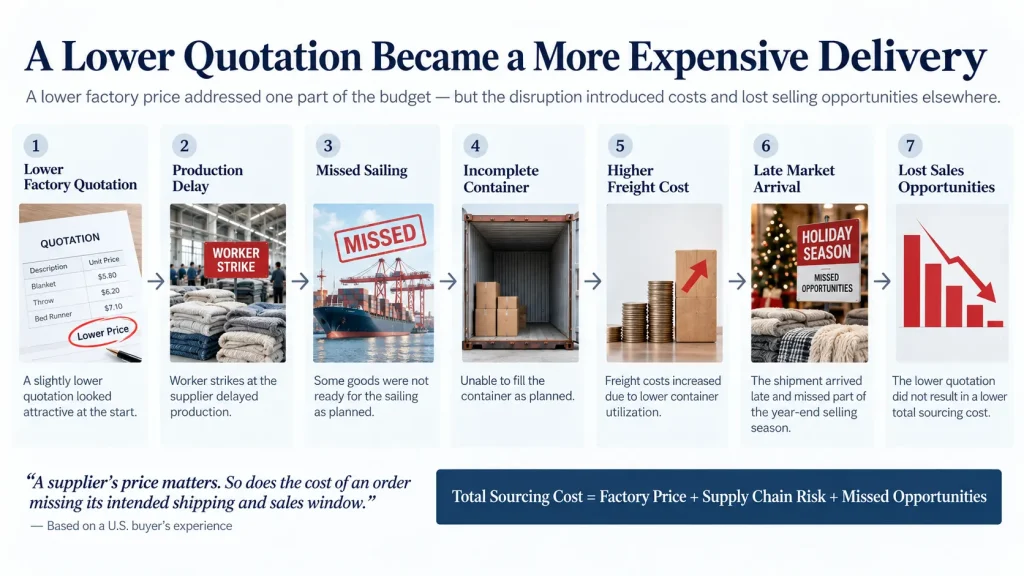
Peter told us that ongoing worker strikes at his Vietnamese supplier delayed production. Some goods were not ready for the sailing he had booked, leaving him unable to fill the container as planned.
His freight costs increased, while the shipment delay also caused him to miss part of the year-end holiday selling season.
The production schedule, shipping plan and final selling window were closely connected. The shipping plan depends on production finishing on time, and the sales plan depends on goods arriving while demand is still strong.
Peter had been trying to protect his budget. The lower quotation addressed one part of that challenge, but the disruption introduced costs and lost selling opportunities elsewhere.
A supplier’s price matters. So does the cost of an order missing its intended shipping and sales window.
His experience describes one supplier relationship, rather than manufacturing conditions throughout Vietnam. For other buyers, its value lies in the question it raises: how much room does your sourcing plan have for a production delay?
2. The Difference Peter Saw in Blanket Workmanship
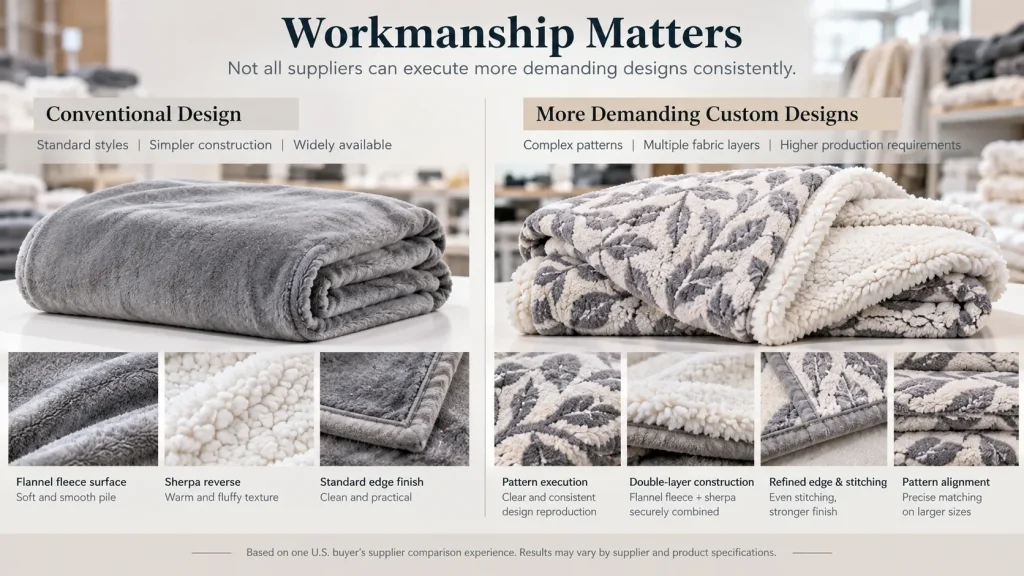
Delivery was not the only point Peter raised with us. He also preferred the workmanship of the blankets supplied by Apex.
Based on his experience with the two suppliers, he felt that Apex achieved better results on more demanding patterns and styles. He described the alternative factory as more comfortable with conventional designs and processes, with less satisfactory results when the work became more complex.
For buyers sourcing flannel fleece and sherpa blankets, this is a useful distinction. This distinction can matter when choosing a blanket manufacturer for custom or more demanding designs.
A supplier may manufacture the general product category while still needing to demonstrate its ability to execute your particular design.
A meaningful comparison should cover the approved appearance and feel, the specifications of both fabric layers, and the finished construction. A quotation becomes more useful when those requirements are clear.
Peter attributed the difference he observed partly to China’s accumulated manufacturing experience. At Apex, we see the practical value of that experience in the work required to take a design through development and into bulk production.
3. Why China Remains Relevant to U.S. Blanket Sourcing
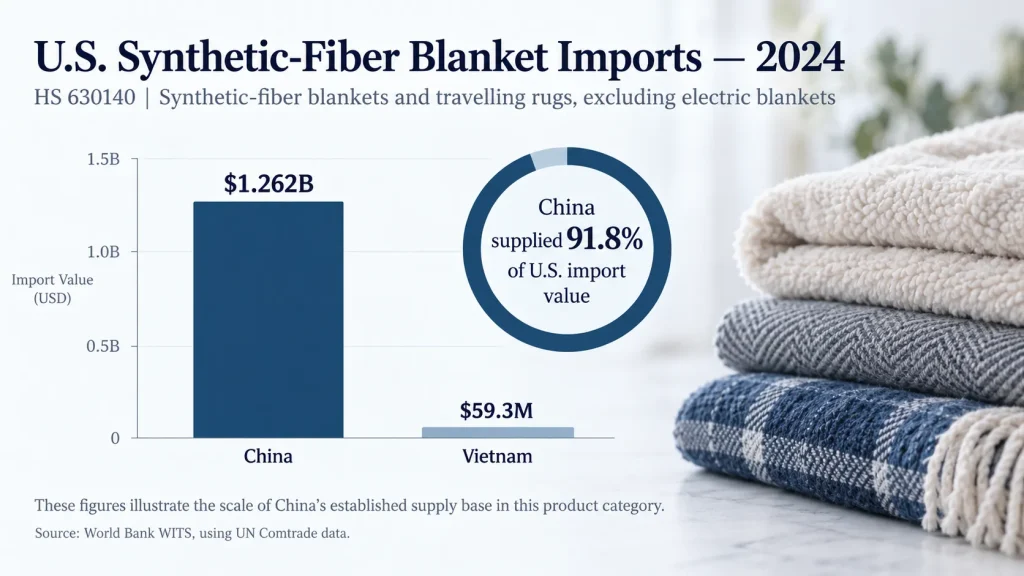
Trade data provides some context for the manufacturing base behind these products.
In 2024, the United States imported approximately $1.374 billion in synthetic-fiber blankets and travelling rugs, excluding electric blankets, under HS 630140. China supplied approximately $1.262 billion—about 91.8% of import value—compared with approximately $59.3 million from Vietnam.
Source: World Bank WITS, using UN Comtrade data
These figures describe one product category in one year. They demonstrate the scale of China’s established supply base; they do not establish that every Chinese supplier performs equally well or that orders are universally returning to China.
For Peter, the more immediate evidence came from his own orders: Apex shipped its allocated volume on time, and he valued the workmanship we delivered.
For a U.S. buyer evaluating a China blanket supplier or China blanket manufacturer, the question is not simply where the product can be made at the lowest quoted price.
4. What Apex’s 19 Years of Experience Mean for Buyers
Apex Textile Mill is a Chinese textile manufacturer and blanket factory that continues to serve U.S. customers through this changing sourcing environment.
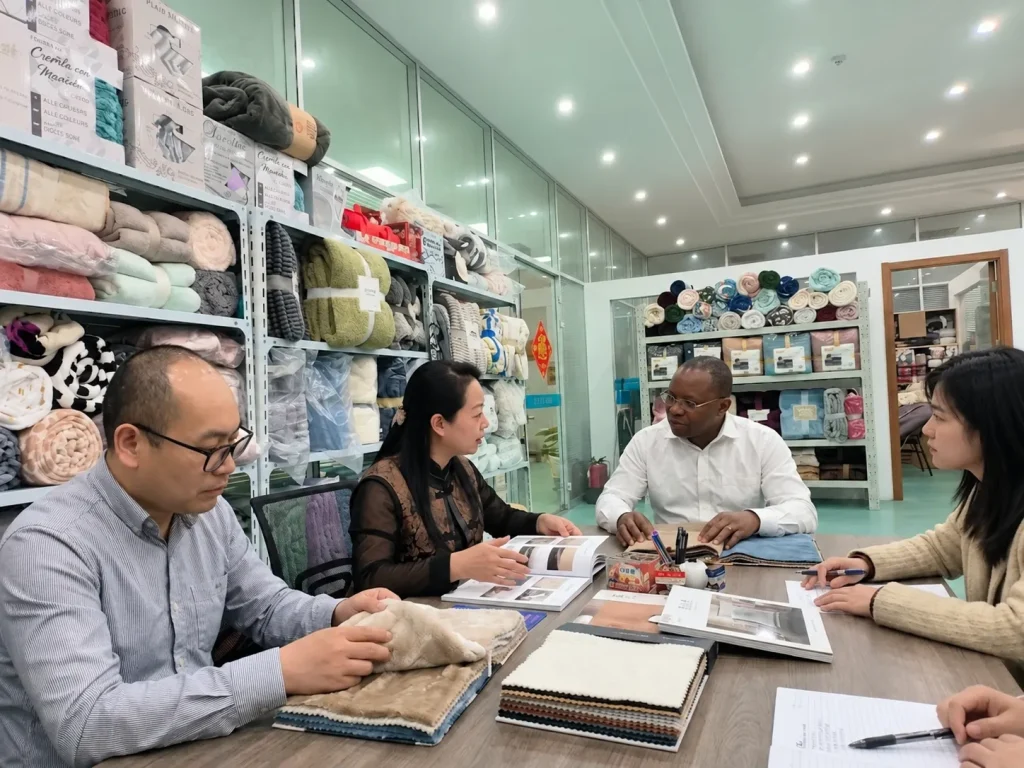
We bring 19 years of textile and home textile experience, with capabilities spanning fabric development, finished products, bulk production and production management. Our experience includes OEM manufacturing for well-known brands in the United States, Europe, Japan, and South Korea, with a particular focus on custom blanket manufacturing and private-label home textile programs.
Beyond blankets, our manufacturing capabilities also extend to bedding sets, quilts and comforters, curtains, and other home textile products, supporting buyers across multiple product categories.
For a buyer evaluating us, that experience should have a practical meaning.
4.1 From Fabric Development to Finished Blankets
A double-layer blanket brings together two fabric surfaces and a finished construction. Decisions about each layer need to support the intended appearance, feel and product requirements.
Our experience across fabrics and finished home textiles allows us to consider those decisions together. Development discussions can address how the product will be made in bulk, alongside how the sample should look and feel.
This becomes particularly relevant when a buyer’s design requires more than a conventional style.
4.2 Experience with Overseas Brand Requirements
Years of OEM work across different markets have given us experience with customers’ product expectations and the management demands behind their orders.
A specification is part of a wider requirement: the buyer needs an acceptable finished product, clear coordination and production that supports a commercial schedule. For seasonal programs, that schedule may be tied to a selling window that cannot simply move with the shipment.
Our role includes understanding those requirements through development and bulk manufacturing.
4.3 Delivery Performance Demonstrated by This Order
In Peter’s case, the result was concrete: Apex completed and shipped the portion entrusted to us on schedule.
One order is not a guarantee against every future disruption. It is, however, a relevant example of our performance for a customer who was comparing sourcing options under real budget pressure.
Together with Peter’s feedback on workmanship, it gives buyers something specific to consider when evaluating the experience behind our quotation.
5. What to Compare Before Moving Your Next Blanket Order
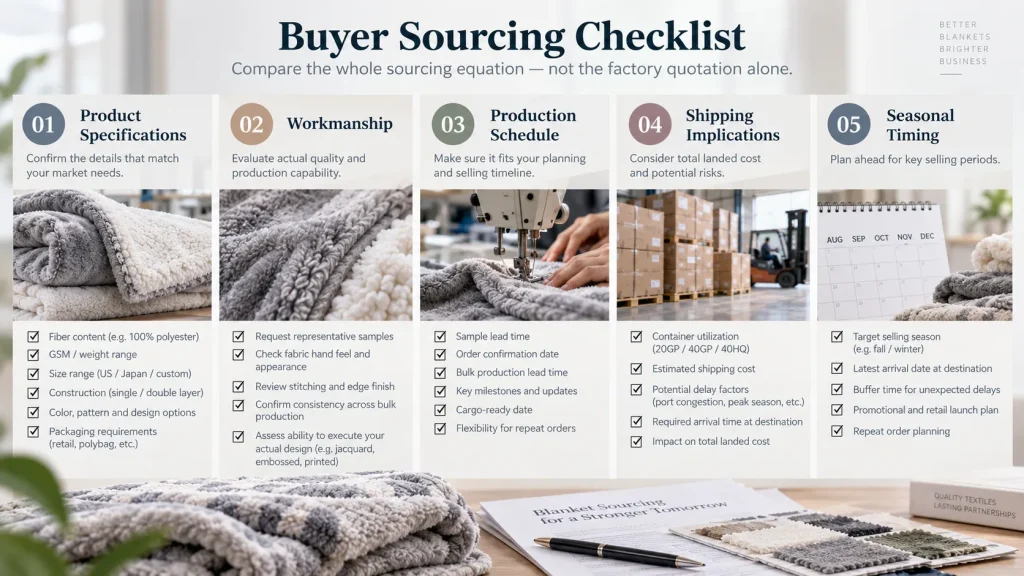
If you are reviewing suppliers for the U.S. market, Peter’s experience offers a practical starting point. Compare the same product requirements, then examine what happens between sample approval and shipment.
| What to compare | What to clarify with the supplier |
| Product specifications | Fiber composition, each layer’s GSM, size, design, construction and packaging |
| Workmanship | A representative sample that demonstrates your actual design requirements |
| Production schedule | Approval deadlines, production milestones and the required cargo-ready date |
| Shipping implications | How incomplete quantities or delays would affect container utilization |
| Seasonal timing | The latest arrival date that still supports your intended selling window |
Tariffs belong in that evaluation, alongside the supplier quotation, freight and the operational consequences of delay.
At Apex, we understand why customers explore alternatives. Peter’s experience also shows why an established manufacturing relationship continues to deserve consideration: the ability to execute the product and fulfill the order has commercial value.
Planning a flannel fleece and sherpa blanket order for the U.S. market? Send Apex Textile Mill your design, fabric specifications, quantity, packaging requirements and target delivery date. We can discuss development and bulk production with your next selling season in mind.
FAQ
U.S. buyers may continue sourcing blankets from China when manufacturing capability, supply-chain depth, product consistency, and delivery performance outweigh the additional tariff cost. For custom blankets, private-label programs, or products with more demanding fabrics and constructions, the lowest factory quotation does not always result in the lowest overall sourcing cost. Buyers therefore need to evaluate tariffs together with product execution, freight, production reliability, and the commercial impact of delays.
Vietnam can be a suitable sourcing option for some U.S. blanket programs, but it is not automatically a better alternative to China. The right sourcing location depends on product specifications, fabric requirements, customization needs, order volume, production capacity, lead times, and total landed cost. Buyers developing custom or private-label blankets should compare the capabilities of individual manufacturers rather than making a sourcing decision based on tariffs or country of origin alone.
China remains competitive in custom blanket manufacturing because of the combination of an established textile supply base and extensive experience taking products from development into bulk production. Access to fabrics, dyeing and finishing, printing, sewing, packaging, and other supporting processes gives manufacturers greater flexibility when specifications or designs change. This can be particularly valuable for private-label blankets or more demanding constructions where consistent execution at bulk-production scale matters as much as the initial sample.
U.S. buyers should evaluate a blanket manufacturer’s material capabilities, sampling process, quality-control procedures, customization options, MOQ, production capacity, lead times, packaging capabilities, and export experience. For the product itself, buyers should confirm fiber composition, GSM, finished dimensions, design, construction, workmanship, and packaging requirements. The key question is whether the manufacturer can consistently reproduce the approved sample in bulk production and meet the required cargo-ready date.
Buyers should compare the expected total sourcing cost rather than the factory quotation alone. This includes product cost, tariffs and duties, freight, customs-related expenses, packaging, and quality-control costs, as well as the potential commercial impact of production delays, missed sailings, incomplete container utilization, or late arrival into a seasonal selling window. A slightly higher factory price may ultimately be more cost-effective when it is supported by more consistent production and reliable delivery.
U.S. buyers can reduce sourcing risk by defining and verifying product requirements before bulk production begins. For blankets, this should include the approved fabric and fiber composition, GSM, finished dimensions, construction, color or pattern requirements, workmanship standards, packaging, labeling, and cargo-ready date. Buyers should approve representative samples, confirm production milestones, and maintain quality control during bulk production. For repeat programs, working with a manufacturer that already understands the buyer’s specifications can also reduce development and communication risk.