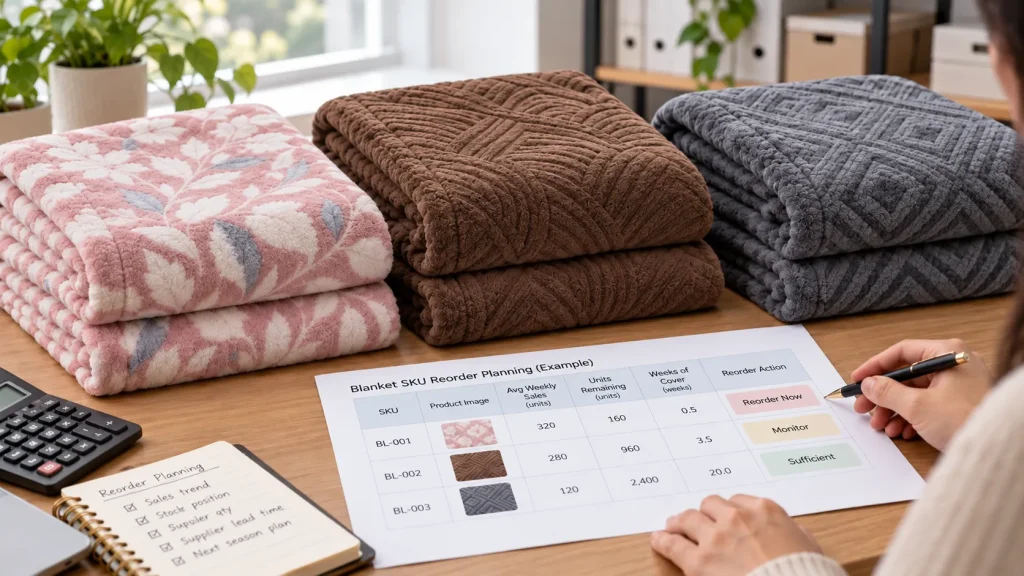
Your first blanket order is selling, but not every color is performing as expected. One SKU is running low, while another is still sitting in the warehouse.
Now comes the harder decision: when should you reorder, which products need replenishment, and how much inventory should you commit to next?
Wait too long, and a popular blanket may sell out before replacement stock arrives. Order too aggressively, and slower-moving inventory can tie up cash that a growing brand needs elsewhere.
For brands working with a custom blanket manufacturer, blanket reorder planning means balancing sales evidence with inventory coverage, replenishment lead time, minimum order quantities (MOQs), and the production requirements of the next order.
The goal is to act before stock becomes critical without treating a short-term sales spike as a guarantee of future demand.
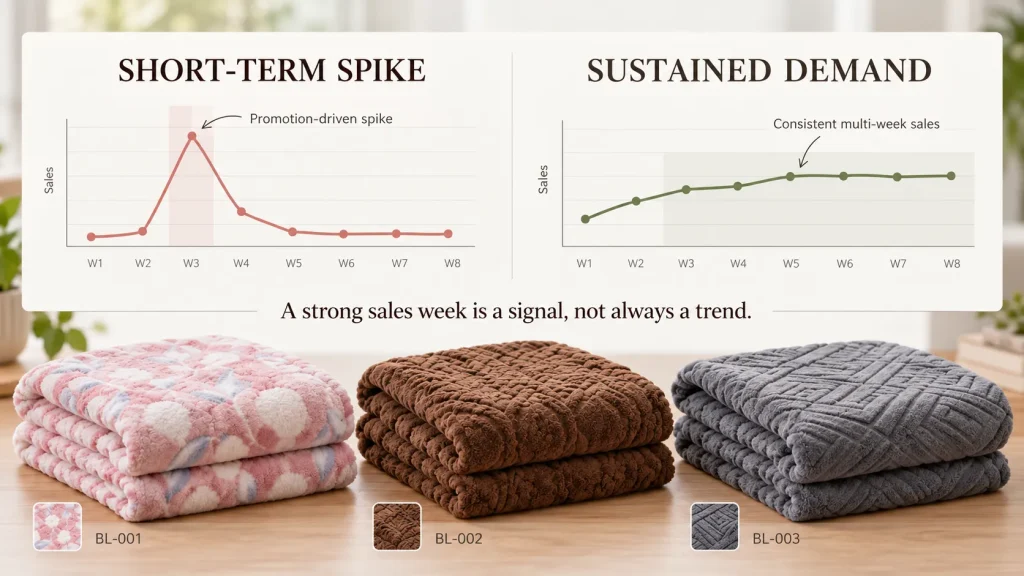
1. A Strong Sales Week Is a Signal, Not Always a Trend
A successful product launch does not automatically tell a brand what to order next.
Imagine a new blanket collection launched in three colors. After several weeks, the neutral color is selling steadily, the darker color has gained momentum following a promotion, and the third color is moving more slowly than expected.
The first order was based largely on a forecast. The next order can be informed by actual sales, but the available evidence may still be incomplete.
A temporary promotion or seasonal shopping period can make one SKU appear stronger than its normal demand level. At the same time, waiting for months of sales history can leave too little time to replenish stock before it runs out.
The practical goal is to distinguish a promising sales signal from a more reliable pattern.
Before placing another order, review sales and remaining inventory by SKU. Ask whether sales have remained consistent over several weeks, whether a promotion caused an unusual spike, and whether an upcoming campaign or seasonal period could materially affect demand.
Looking at the entire collection can be misleading. One bestseller may be carrying weaker products, while a temporary sales spike may make another color appear more promising than it really is.
The next order should reflect what each SKU is showing, rather than automatically repeating the original product mix.
2. When Should You Reorder? Compare Stock Coverage with Replenishment Lead Time
Having stock in the warehouse does not necessarily mean there is enough time to replenish it before a product sells out.
The more useful question is: Will the remaining inventory last until the next shipment is ready for sale?
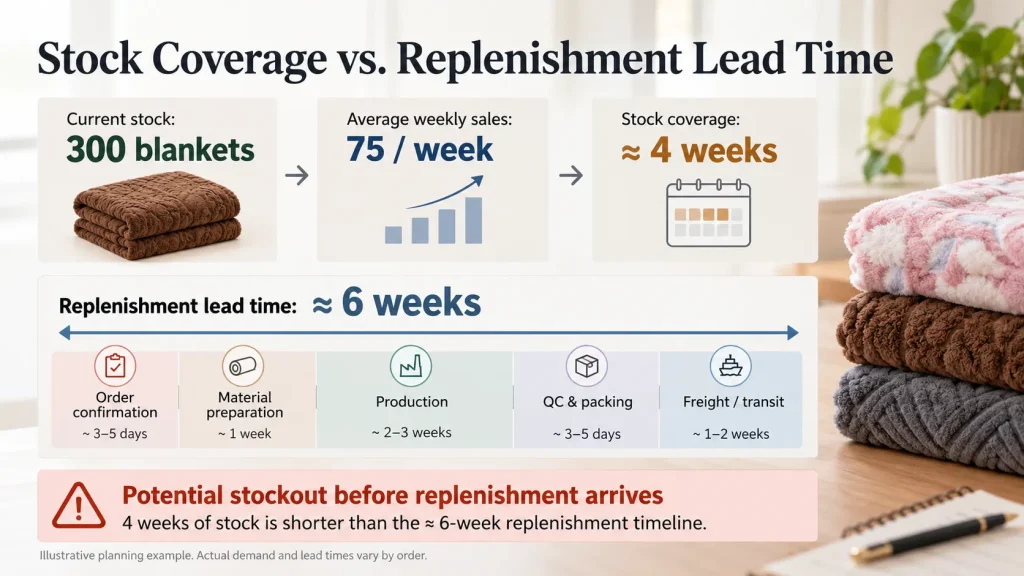
Consider a simple example. A brand has 300 blankets remaining, and recent sales average 75 blankets per week. At that rate, the current inventory represents approximately four weeks of stock coverage.
Simple stock-coverage estimate: Stock coverage (weeks) = units remaining ÷ average weekly sales.
If the expected replenishment timeline is six weeks from order confirmation to the arrival of saleable stock, the brand may run out before the next shipment arrives.
This is a planning example, not a guarantee of future sales or delivery timing. Actual demand may fluctuate, and the timeline must be confirmed for the specific order.
The calculation nevertheless highlights an important point: reorder planning needs to consider both sales velocity and the total replenishment lead time, not just the supplier lead time in isolation.
Production Lead Time Is Only Part of the Replenishment Timeline
A manufacturer’s production lead time covers the manufacturing portion of an order. The buyer’s total replenishment timeline may also include order confirmation, material preparation, production scheduling, quality checks, packing, freight, and transit.
For inventory planning, the buyer needs to understand when replenished stock is expected to become available for sale, not only how long the factory needs to manufacture it.
A repeat order using an approved specification may be more straightforward than a newly developed product. However, the previous order’s timeline should not automatically be assumed to apply again. Material availability, factory scheduling, order quantity, and shipping arrangements still need to be reconfirmed.
The best time to discuss a reorder is generally before inventory becomes critical, while there is still time to evaluate the available options.
3. How Much Should You Reorder?
Once a reorder is being considered, the next challenge is deciding how much inventory to commit.
Returning to the three-color collection, the neutral blanket may justify a larger repeat order because its sales have remained consistent. The darker color may warrant a more cautious increase if its recent performance was influenced by a promotion. The slower-moving color may need a smaller reorder or no immediate replenishment, depending on remaining stock and expected demand.
Repeating the original quantities is simple, but it can ignore what the first launch has taught the buyer. Moving most of the next order into the current bestseller can also be risky if its recent performance does not reflect normal demand.
A more practical approach is to assess each SKU against several factors.
Sales consistency: Is demand stable, gradually improving, or dependent on occasional promotions?
Remaining inventory: How much stock is available, and how quickly is it being sold?
Expected demand: Could seasonality or planned marketing activity materially change sales?
MOQ and production constraints: Does the applicable minimum order quantity make a small replenishment practical? For custom blankets, MOQ may depend on fabric, color, construction, and production requirements.
Inventory commitment: How much additional stock is the business prepared to carry if demand slows after the reorder?
These factors can point in different directions. A popular blanket may need replenishment soon, while the manufacturer’s MOQ makes a very small production run impractical.
The buyer is therefore balancing three risks: over-ordering, under-ordering, or waiting so long that the replenishment window becomes too tight.
There is no single reorder quantity that works for every product. The right decision should reflect actual sales, remaining inventory, expected replenishment timing, production constraints, and the business’s capacity to carry additional stock.
4. A Repeat Order Is Not Always a Simple Repeat
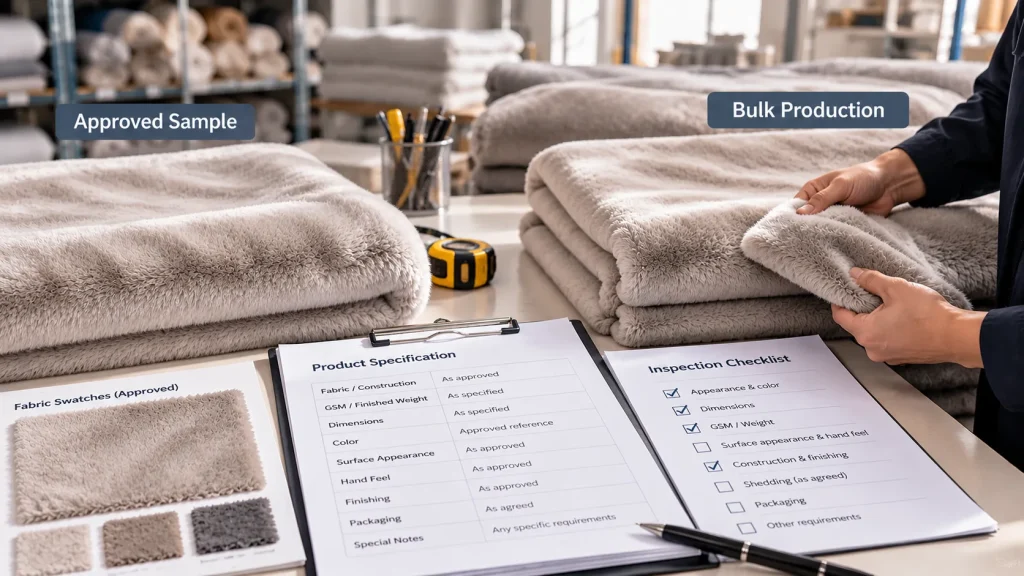
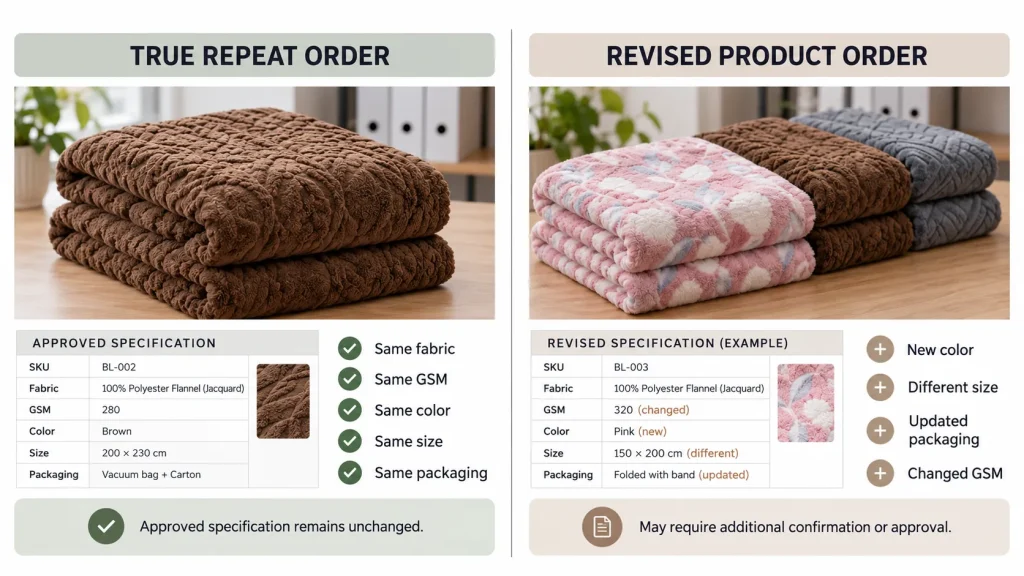
A buyer may say, “We want to reorder the same blanket,” while also requesting a different shade, a new GSM, a revised size, or updated packaging.
From a commercial perspective, these changes may feel minor. From a manufacturing perspective, however, they can change what must be reconfirmed before production begins.
Repeating an approved specification is different from modifying a product while replenishing it.
Before placing the next order, the buyer and manufacturer should review the following points.
| Manufacturing check | Why it matters |
| Approved product specification | Confirms whether fabric, GSM, size, construction, and finishing remain unchanged |
| Material availability | Helps determine whether the same specification can be reproduced under current material and production conditions |
| Color continuity | Checks whether the original shade and quality requirements can still be met |
| Labels and packaging | Confirms whether the previous packing instructions and materials still apply |
| Order quantity and production schedule | Establishes whether the requested quantity can fit the current production plan |
| Specification changes | Identifies whether new sampling or additional material, color, or packaging approval may be necessary |
| Target delivery window | Allows the manufacturer to assess whether the requested timing is achievable |
Not every change requires new sampling or automatically causes a delay. The impact depends on what is changing and which approvals or production preparations are affected.
For example, repeating an approved blanket specification may involve fewer development steps than introducing a different fabric or construction. A packaging change may still require separate confirmation even when the blanket itself remains unchanged.
Clear communication helps both parties distinguish a straightforward repeat order from a revised product order. It also makes the expected production schedule easier to assess before the purchase order is finalized.
5. A Simple Blanket Reorder Planning Framework
Reorder planning does not need to become an elaborate forecasting exercise. For a growing blanket business, the process can be organized around four practical steps.
Step 1: Review sales by SKU.
Identify which colors and designs are selling consistently, which are improving, which depend on promotions, and which are moving slowly.
Step 2: Estimate how long current inventory may last.
Compare remaining stock with recent sales. Interpret the result carefully if sales have been affected by promotions, unusual events, or seasonal demand.
Step 3: Contact the manufacturer before stock becomes critical.
Confirm the applicable MOQ, material and color availability, specification continuity, current production schedule, and expected replenishment timing.
Step 4: Adjust the next order based on the evidence.
Replenish products with sustained demand, remain cautious where demand is uncertain, and avoid automatically repeating the same color or SKU mix used for the initial launch.
After each replenishment cycle, compare actual sales and actual delivery timing with the original plan. This gives the buyer better information for the next decision and helps identify where forecasts or purchasing assumptions need to change.
For a growing brand, the goal is not to eliminate all inventory risk. It is to make the next purchase using better evidence, a clearer understanding of the replenishment timeline, and a realistic view of how much inventory the business is prepared to carry.
A custom blanket manufacturer can clarify the production factors that affect replenishment feasibility. The buyer combines that information with sales performance, remaining inventory, marketing plans, and its own inventory limits to make the final commercial decision.
The best time to discuss a reorder is before existing stock becomes critically low, not after the best-selling product has already sold out.
Frequently Asked Questions
Consider reordering when the remaining inventory may not last through the total replenishment lead time needed to confirm, produce, and deliver the next shipment. Recent sales, expected demand, and the manufacturer’s confirmed timeline should be assessed together.
A simple starting point is to estimate stock coverage: units remaining divided by average weekly sales. Compare the resulting number of weeks with the expected replenishment timeline. This is a planning guide rather than a guarantee because both demand and delivery timing can change.
Not automatically. Review sales and remaining inventory by SKU. Consistently strong products may justify more stock, while slower-moving colors may need less or no immediate replenishment.
MOQ can make a small replenishment order impractical or uneconomical. The applicable minimum may depend on fabric, color, construction, and production requirements. Confirm the MOQ with the manufacturer and compare it with expected demand and inventory risk.
Yes, but changes to fabric, color, GSM, size, construction, or packaging may require additional confirmation or approval. Ask the manufacturer how the proposed changes could affect production preparation and delivery timing.
Planning Your Next Blanket Reorder?
Before finalizing your next purchase order, send Apex Textile Mill the SKUs or colors to replenish, target quantities, delivery window, and any specification changes. We can confirm MOQ, material availability, and timing.